
Photographic History of the United States Navy
ARCHIVE
| NavSource Main Page | FAQ | Contact us | Search NavSource |
| |
NavSource Naval History Photographic History of the United States Navy |
DESTROYER ARCHIVE |


 To Britain October 9 1940, renamed HMS Burnham (H82).
| Click On Image For Full Size Image |
Size | Image Description | Contributed By |
|
|---|---|---|---|---|
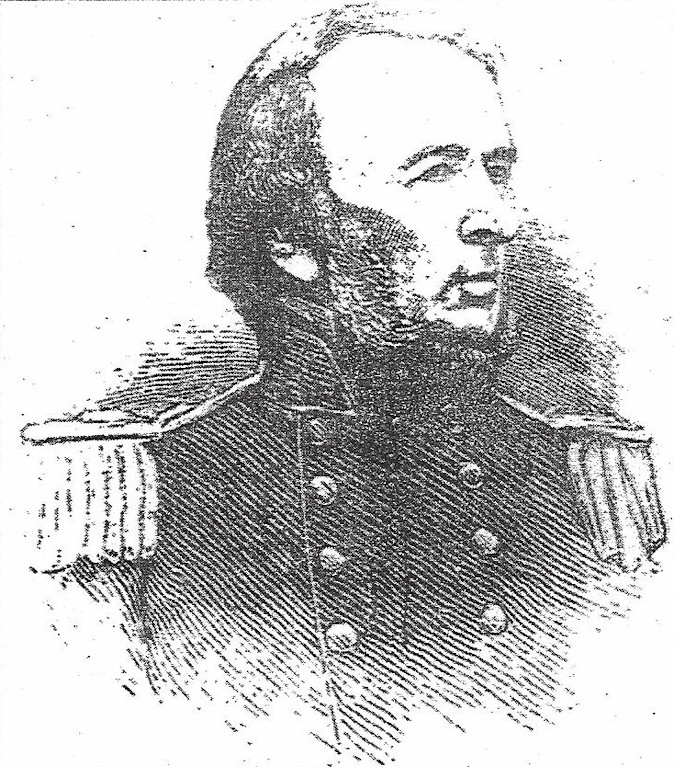 |
214k | John H. Aulick was born in 1787 at Winchester, Va. and was appointed a midshipman on 15 November 1809. During the War of 1812, he served in Enterprise and took part in her battle with HMS Boxer on 4 September 1813. After that engagement ended in a glorious American victory, Aulick served as prize master of the prize. Following the war, he served in Saranac, Ontario, Brandywine, Constitution, and Vincennes. From 1851 to 1853, Aulick commanded the East India Squadron but was forced by ill health to give up command of the projected Japanese expedition to Commodore Matthew C. Perry. Aulick retired in 1861 and died at Washington, D.C., on 27 April 1873. | Bill Gonyo | |
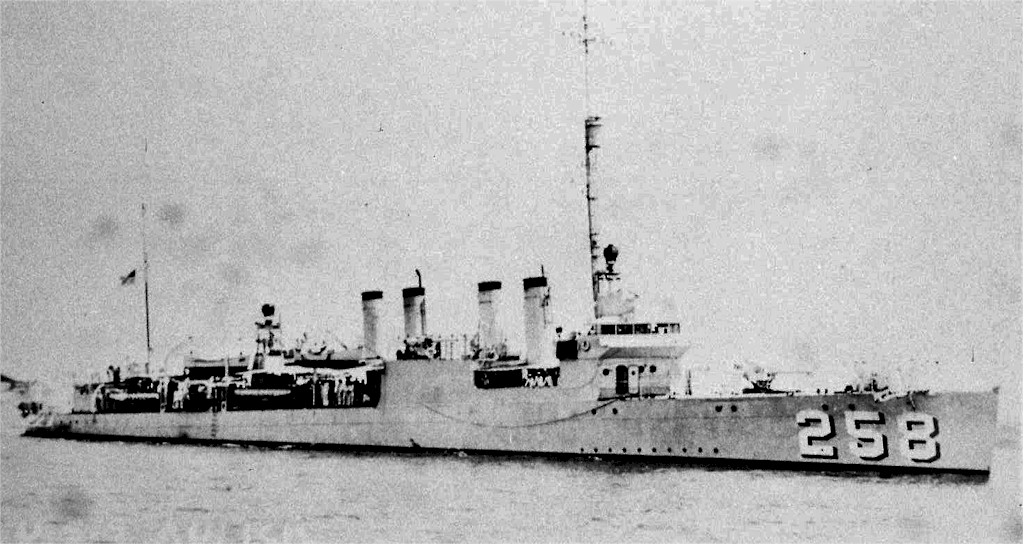 |
163k | Undated, location unknown. Photo from the collection of the Vallejo Naval and Historical Museum. | Darryl Baker | |
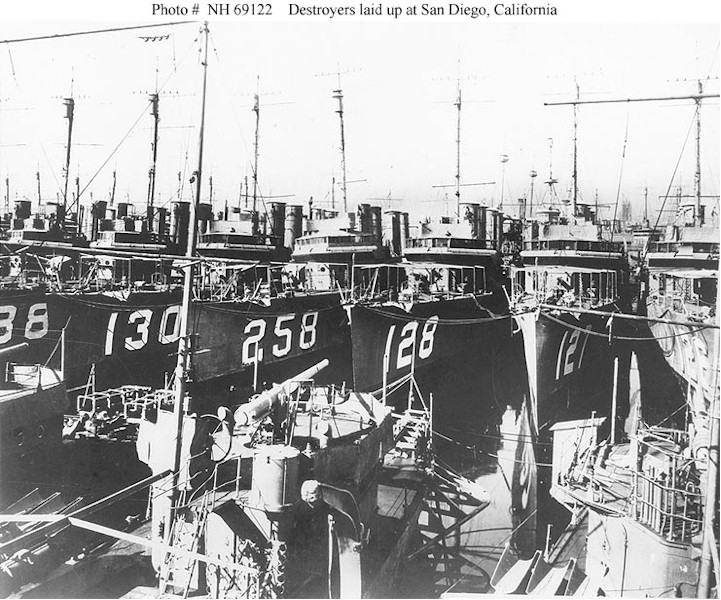 |
153k | Destroyers laid up at San Diego, California. Some of the eighty reserve destroyers in San Diego harbor, part of some 260 destroyers laid up there and at Philadelphia, Pennsylvania. Photograph dated 29 December 1926. Identifiable ships present include (from left to right): USS Kennison (DD-138); USS Jacob Jones (DD-130); USS Aulick (DD-258); USS Babbitt (DD-128); USS Twiggs (DD-127); and USS Badger (DD-126). Courtesy of the San Francisco Maritime Museum, San Francisco, California, 1969. U.S. Naval Historical Center Photograph. | Fred Weiss | |
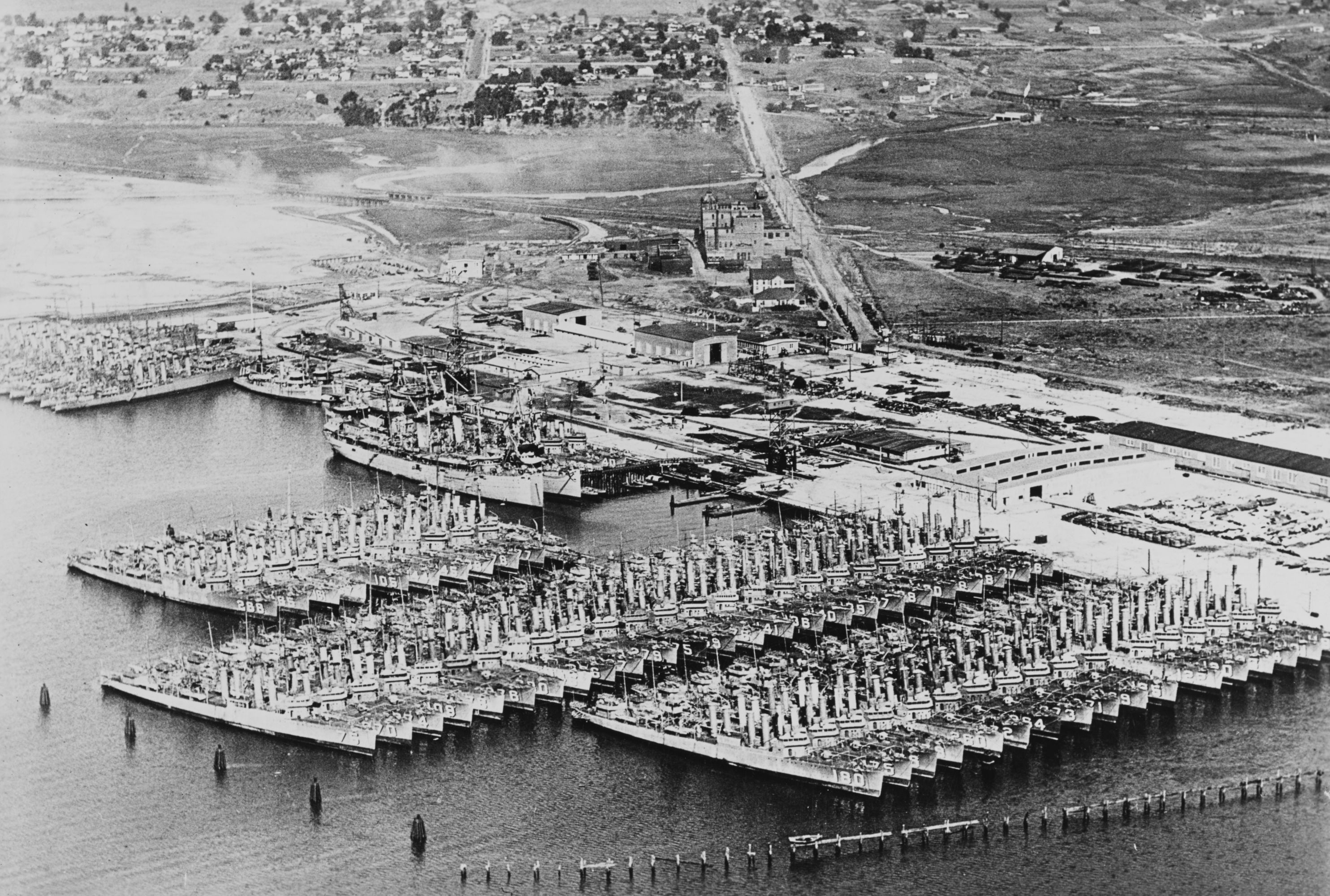 |
195k | Red Lead Row, San Diego Destroyer Base, California. Photographed at the end of 1922, with at least 65 destroyers tied up there. Ships present are identified as: (left to right, in the right diagonal row): Stansbury (DD-180); MacKenzie (DD-175); Renshaw (DD-176); Howard (DD-179); Gillis (DD-260); Tingey (DD-272); McLanahan (DD-264); Swasey (DD-273); Morris (DD-271); Bailey (DD-269); Tattnall (DD-125); Breese (DD-122); Radford (DD-120); Aaron Ward (DD-132) -- probably; Ramsey (DD-124); Montgomery (DD-121); and Lea (DD-118). (left to right, in the middle diagonal row): Wickes (DD-75); Thornton (DD-270); Meade (DD-274); Crane (DD-109); Evans (DD-78); McCawley (DD-276); Doyen (DD-280); Elliot (DD-146); Henshaw (DD-278); Moody (DD-277); Meyer (DD-279); Sinclair (DD-275); Turner (DD-259); Philip (DD-76); Hamilton (DD-141); Boggs (DD-136); Claxton (DD-140); Ward (DD-139); Hazelwood (DD-107) or Kilty (DD-137); Kennison (DD-138); Jacob Jones (DD-130); Aulick (DD-258); Babbitt (DD-128); Twiggs (DD-127); and Badger (DD-126). (left to right, in the left diagonal row): Shubrick (DD-268); Edwards (DD-265); Palmer (DD-161); Welles (DD-257); Mugford (DD-105); Upshur (DD-144); Greer (DD-145); Wasmuth (DD-338); Hogan (DD-178); O'Bannon (DD-177); and -- possibly -- Decatur (DD-341). (Nested alongside wharf in left center, left to right): Prairie (AD-5); Buffalo (AD-8); Trever (DD-339); and Perry (DD-340). Minesweepers just astern of this group are Partridge (AM-16) and Brant (AM-24). Nearest ship in the group of destroyers at far left is Dent (DD-116). The others with her are unidentified. U.S. Naval Historical Center Photograph. : NH 42539 | Robert Hurst | |
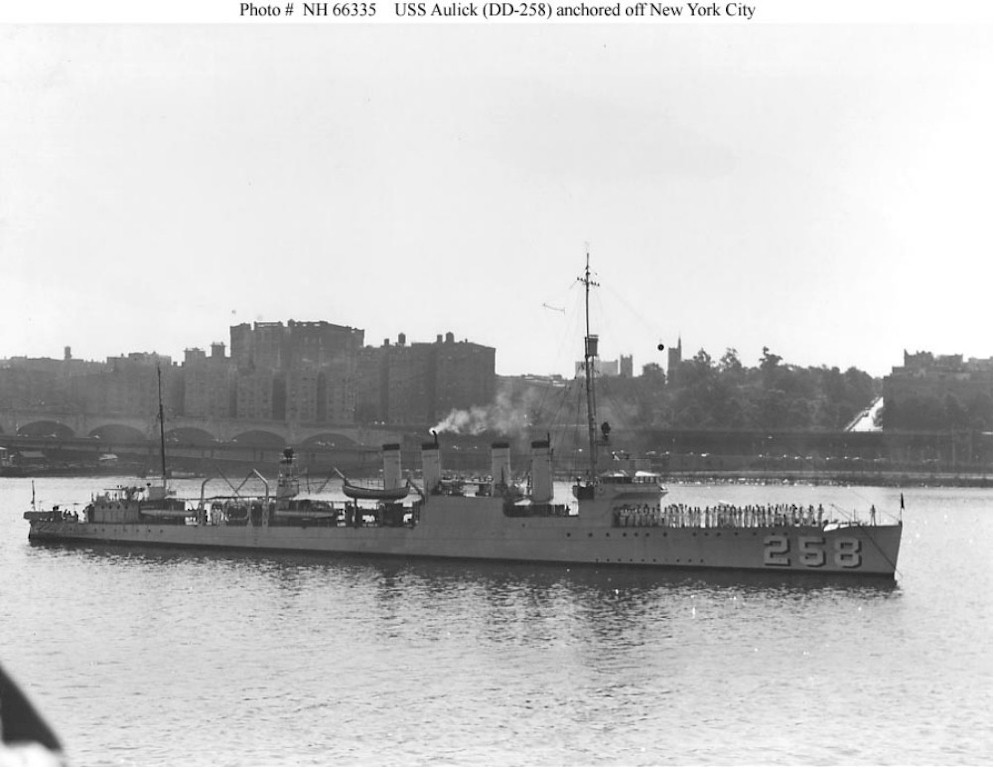 |
113k | USS Aulick (DD-258), anchored off New York City, circa 1939-1940. Photographed by Ted Stone. Courtesy of the Mariners Museum, Newport News, Virginia. Ted Stone Collection. U.S. Naval History and Heritage Command Photograph. Photo #: NH 66335. | Robert Hurst | |
| On British Service |
||||
| HMS Burnham (ex-USS Aulick, DD-258) Commissioned at Halifax, NS on 8 October 1940, Burnham sailed for Devonport on 16 October 1940 and completed a brief refit to work up at Scapa Flow on 12 November 1940. Her first task on joining Western Approaches Command was to escort the new fleet carrier HMS Formidable from Belfast to the Clyde, followed by bringing in convoy SL56. Weather damage incurred during this last task placed her under repair at Belfast from 17 December 1940 to 30 January 1941. Once repairs were complete, Burnham joined 12th Escort Group operating in UK waters; however a collision with the destroyer HMS Malcolm on 3 March 1941 sent her into Liverpool for repairs lasting until 27 April 1941. On completion, the ship proceeded westward, first to Iceland where 12EG was now based, then to St John's, NF in late May 1941 to join the Newfoundland Escort Force. A further collision, this time with her sister HMS Chesterfield, put Burnham into Boston for repair from mid-September 1941 to 23 October 1941, after which she resumed escort duty from St John's. In mid-March 1942 she went south to Charleston, SC for a six week refit, followed by a month's duty based on Bermuda, after which she returned to the RCN remaining in Canadian waters until called home for refit on the Thames during November and December 1942. On completion of refit and work up, Burnham joined the Canadian C3 Escort Group and remained on trans-Atlantic escort duty until late 1943. By that date Burnham had returned to Western Apporaches Command and a refit at Liverpool for use as an Air Target Ship, lasting until March 1944. Duty as a target lasted eight months, with Burnham paying off to reserve at Milford Haven on 1 December 1944 where she lay until listed for disposal in March 1947 finally arriving at Pembroke Dock 2 December 1948 to be broken up by R S Hayes. (Foreign service history thanks to Robert Hurst.) | ||||
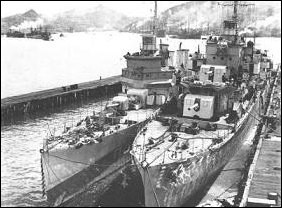 |
26k | The "Town" Class destroyer HMS Burnham (H82) tied up outboard of the Canadian destroyer HMCS Saskatchewan (H70), alongside at either St. Johns or Halifax. Photo from http://www.burnham-on-sea.com/hmsburnham-history.shtml. | Robert Hurst | |
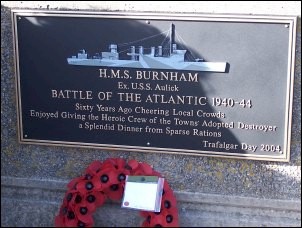 |
27k | Plaque dedicated to the Officers and Men of HMS Burnham (ex-USS Aulick) on the seafront of Burnham-on-sea, 21 October 2004. Photo taken from http://www.burnham-on-sea.com. | Robert Hurst | |
 |
47k | The 'Town' class destroyer HMS Burnham (ex-USS Aulick, DD-258) underway sometime between May and October 1942 location unknown. She has Type 271 radar on a newly extended bridge but no HF/DF. Type 286 radar tops the foremast, centerline torpedo tubes are fitted and, unusually, the searchlight has been replaced in its tower by a third 2Omm AA gun to augment the beam guns. The sided pennant number aft is also unusual in RN practice, possibly applied during her Charleston, SC, refit in March 1942 (Admiralty Official). | Robert Hurst | |
LCDR Lee Payne Johnson    Jul 26 1919 - Oct 16 1920
LCDR Howard Stafford Jeans    Oct 16 1920 - May 22 1922
(Decommissioned May 22 1922 - June 18 1939)
LCDR Roland Nesbit Smoot    Jun 18 1939 - Oct 8 1940 (Later VADM)
| Back To The Main Photo Index | To The Destroyer Index Page |
