
Photographic History of the United States Navy
ARCHIVE
| NavSource Main Page | FAQ | Contact us | Search NavSource |
| |
NavSource Naval History Photographic History of the United States Navy |
DESTROYER ARCHIVE |


| Click On Image For Full Size Image |
Size | Image Description | Contributed By |
|
|---|---|---|---|---|
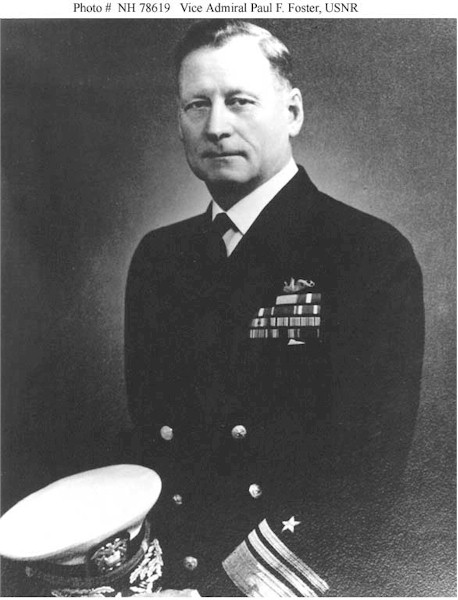
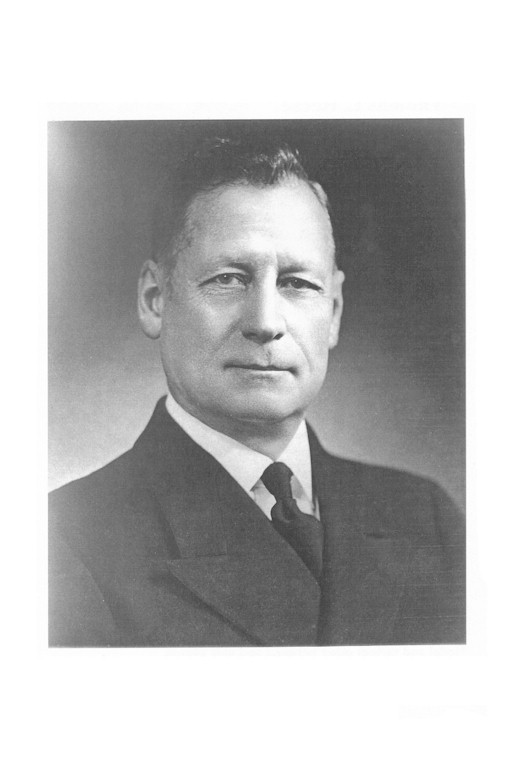
| 62k | Paul Frederick Foster was born in Wichita, Kansas on 25 March 1889, and attended the University of Idaho and was then appointed to the U.S. Naval Academy, graduating with the class of 1911. Following graduation he joined the USS Washington (CA-11) in which he served until December of that year, when he was transferred to the newly commissioned USS Utah (BB-31). While serving in UTAH, he participated in the Mexican Campaign, and was awarded the Congressional Medal of Honor, for "Distinguished conduct in battle engagements of Vera Cruz, 21 & 22 April 1914. In both days, fighting at the head of his company, Ensign Foster was eminent and conspicuous in his conduct, leading his men with skill and courage." In December 1914 Admiral Foster had submarine instruction aboard the USS Prairie (AD-5) and the USS G-4 (SS-26). In February 1916, he assumed command of G-4. He was then assigned to command the USS AL-2 (SS-41), which, while operating off Bantry Bay was credited with sinking the German submarine (UB-65), one of three officially listed as sunk by the U.S. Navy. While in command, he was awarded the Distinguished Service Medal for "Exceptionally meritorious service in a duty of great responsibility as commanding officer of the USS AL-2 in an encounter with an enemy submarine on 10 July 1918, in which the enemy submarine was sunk." In January 1924 he was ordered to Philadelphia to assist in fitting out the USS Trenton (CL-11), and he served aboard as Engineering Officer upon commissioning on 19 April 1924. In January 1927 he was awarded the Navy Cross for "Extraordinary heroism on the occasion of the turret explosion on board the USS TRENTON." Lieutenant Commander Foster was the first man to receive all three of the Navy's highest awards. From March 1927, when he resigned his regular commission, he was active in various civilian organizations, some directly involved with U.S. Military functions. In 1941 he was recalled to active duty where he served on the Navy Inspector General's Staff and during World War II conducted three major inspections at personal direction of President Roosevelt. In June 1954, Admiral Foster joined the staff of the Atomic Energy Commission as special assistant to the General Manager for International Activities and on 1 July 1957 he was appointed General Manager of the AEC, where he served until June 1958. In 1959, President Eisenhower appointed him to the International Atomic Energy Agency in Vienna, Austria with the rank of Ambassador. He served in this position until 1961. Admiral Foster died in 1972 in Virginia Beach, VA at age 83. Photo #: NH 78619, Vice Admiral Paul F. Foster, USNR (1889-1972) photographed circa the 1950s. As an Ensign, Foster was awarded the Medal of Honor for "distinguished conduct in battle" during the intervention at Vera Cruz, Mexico on 21-22 April 1914. Courtesy of Mr. James Russell. U.S. Naval Historical Center Photograph. | Robert M. Cieri | |
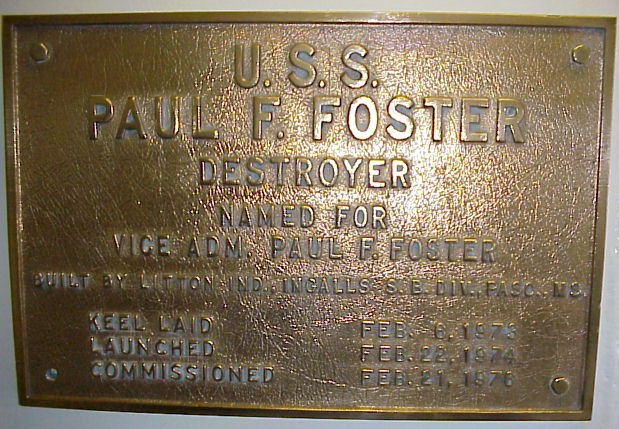
| 114k | Foster's Commissioning Plaque. | Tom Armstrong | |
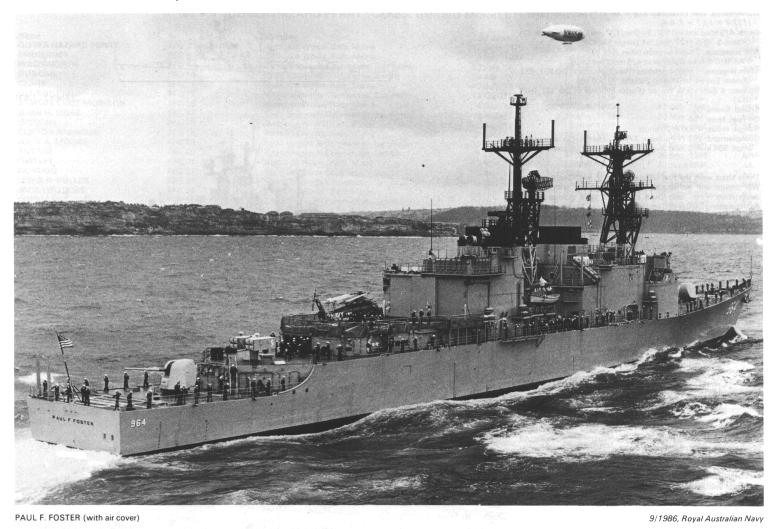
| 68k | Undated, location unknown. | - | |
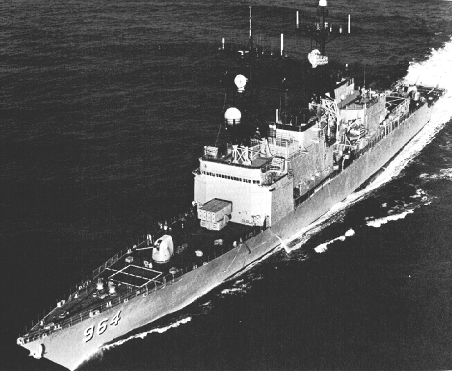
| 130k | Undated, forward view of the Spruance class destroyer, shown at sea, at speed | - | |
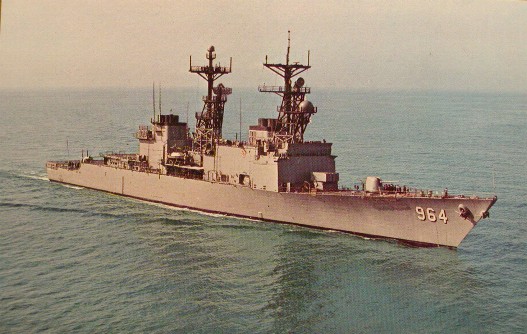
| 58k | Undated postcard Copyright © Marine Photos, San Diego, CA. | Mike Smolinski | |
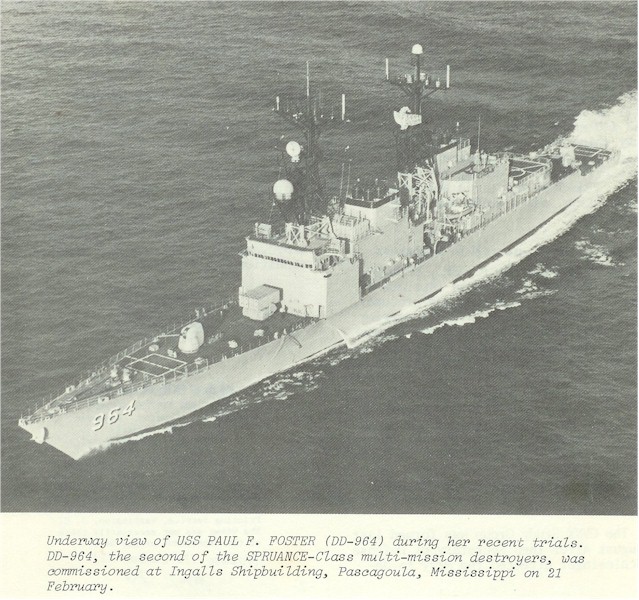
| 130k | Undated image from the NAVSEA Journal. | Bob Bush | |
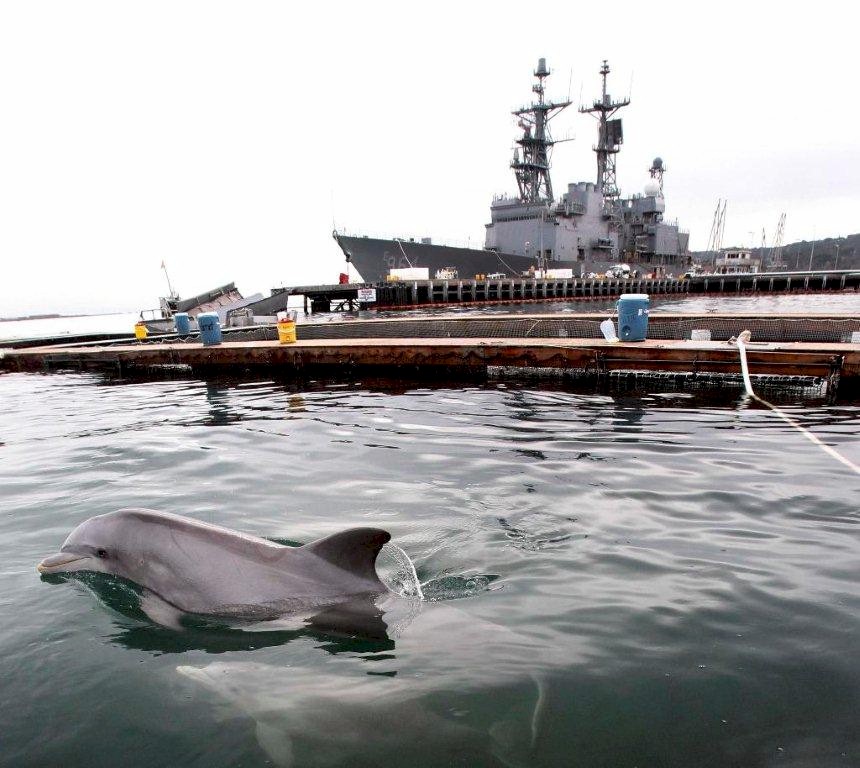
| 137k | Undated, Navy's test ship for experimental weapons and sensors. U.S. Navy Marine Mammal Program based in San Diego, California. Dolphins trained for military uses. | Tommy Trampp | |
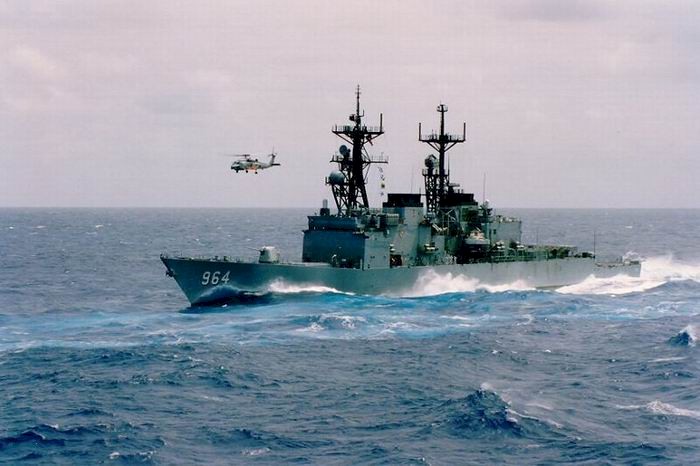
| 68k | Undated, location unknown. | Richard Miller BMCS USNR RET. | |
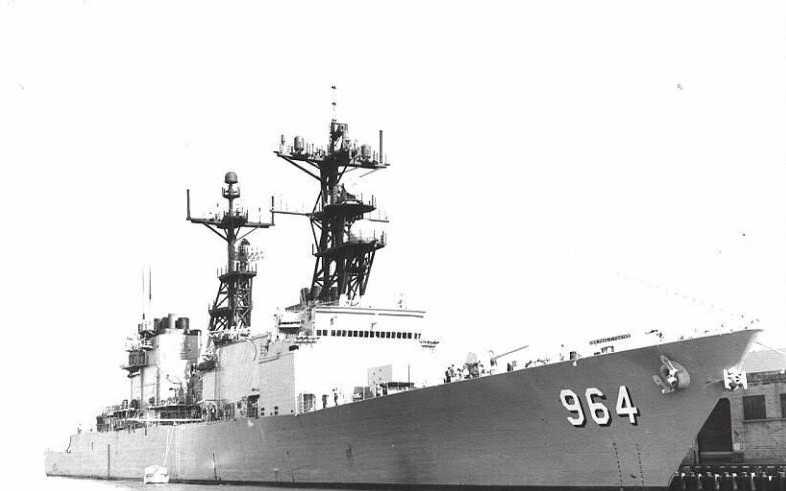
| 51k | Undated, location unknown. | Richard Miller BMCS USNR RET. | |
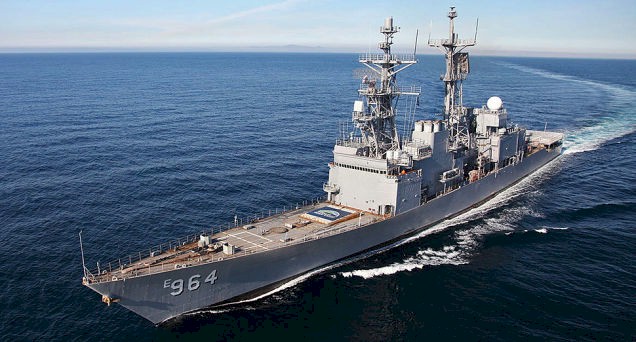
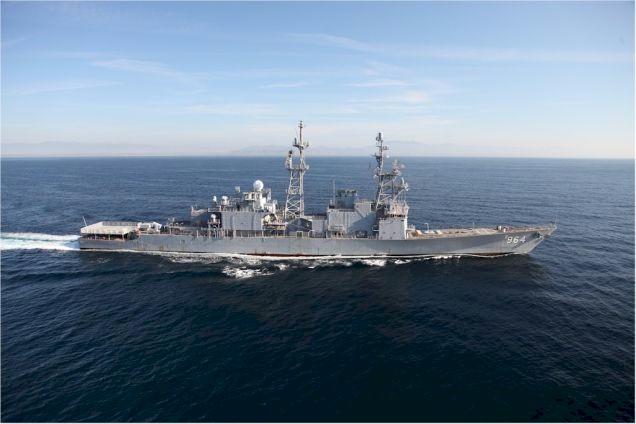
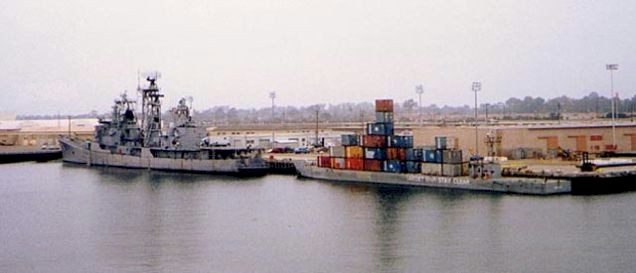
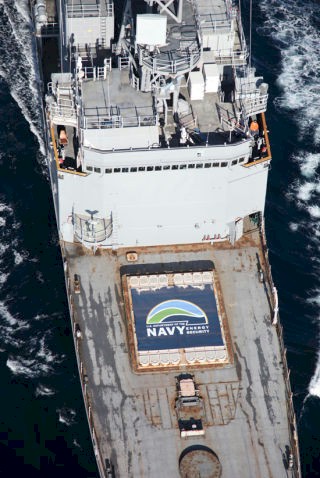 Undated, location unknown. | Ron Reeves | |||
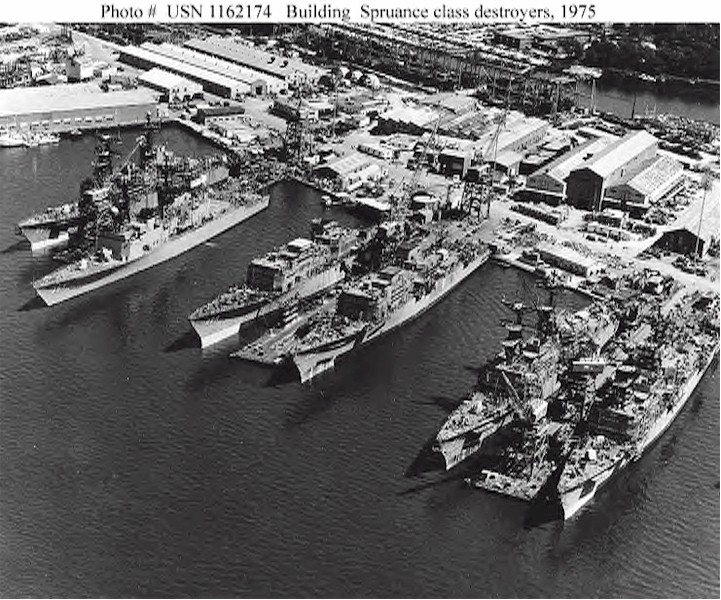
| 166k | Litton East Bank Shipyard, Pascagoula, Mississippi. Six Spruance class destroyers fitting out, circa May 1975. Ships are, from left: Paul F. Foster (DD-964); Spruance (DD-963), then running trials; Arthur W. Radford (DD-968); Elliot (DD-967); Hewitt (DD-966) and Kinkaid (DD-965). Official U.S. Navy Photograph. | Fred Weiss | |
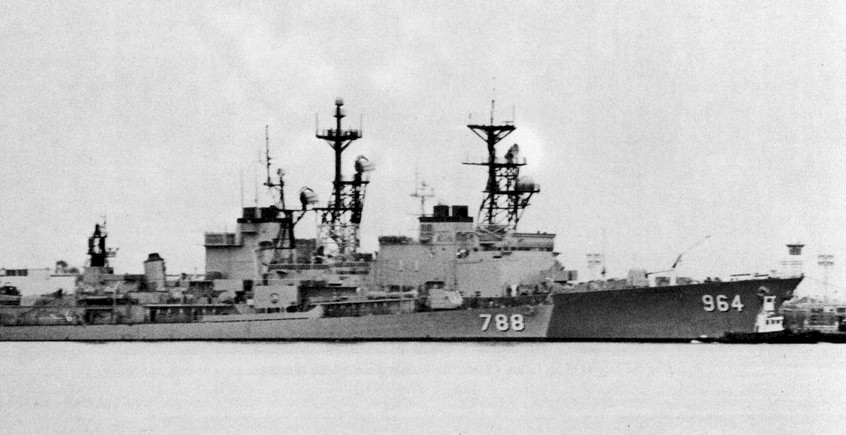
| 90k | Gearing-class destroyer USS Hollister (DD-788) alongside the Spruance-class destroyer USS Paul F. Foster (DD-964), probably at San Diego, California, circa 1976. U.S. Navy photo from the USS Paul F. Foster (DD-964) 1976-77 cruise book. | Robert Hurst | |
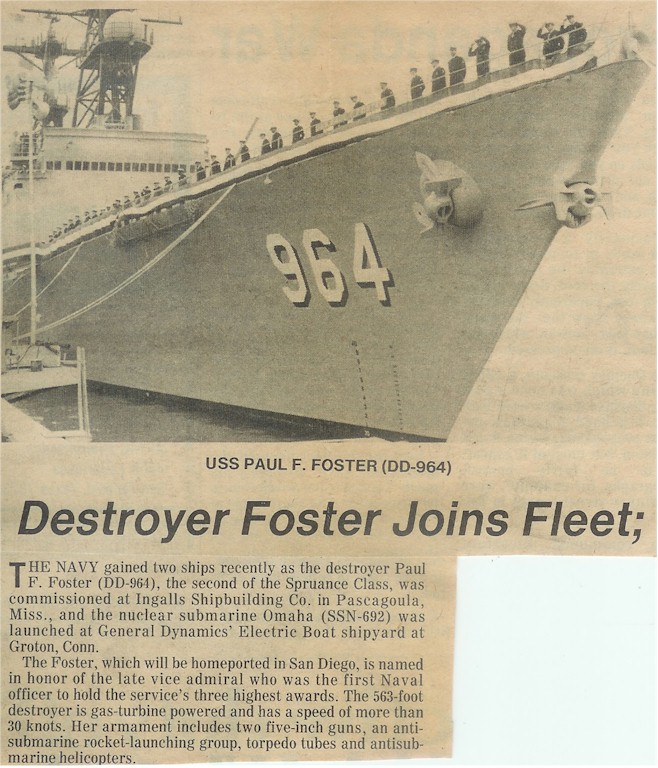
| 155k | Newspaper clipping circa March 1976. | Ron Reeves | |
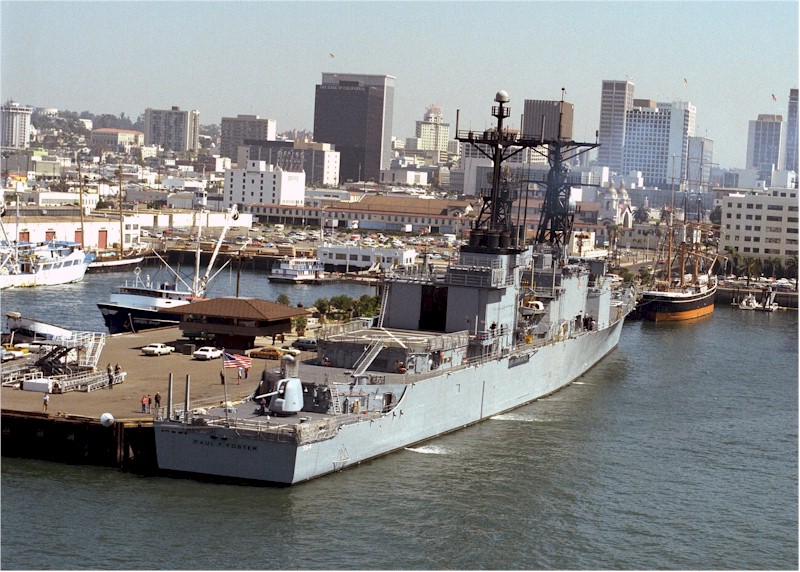
| 164k | DN-SC-85-06064. A starboard quarter view of the destroyer USS PAUL F. FOSTER (DD 964) moored at the Broadway Pier, San Diego. In front of the PAUL F. FOSTER is the SS Star of India. Photo by PH1 A. E. Legare, March 12 1976. | Bill Gonyo | |
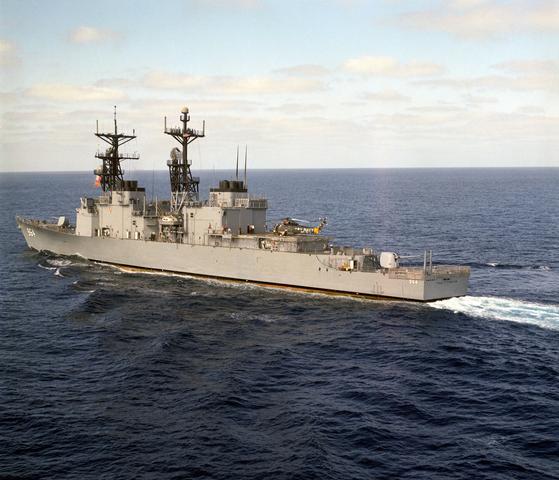
| 43k | DN-SC-85-06045. A port quarter view of the destroyer USS PAUL F. FOSTER (DD 964) underway off the coast of Southern California. A Light Helicopter Anti-submarine Squadron 33 (HSL-33) SH-2F Seasprite helicopter can be seen aboard the ship. Photo by PH1 A. E. LEGARE dated April 2 1976. | - | |
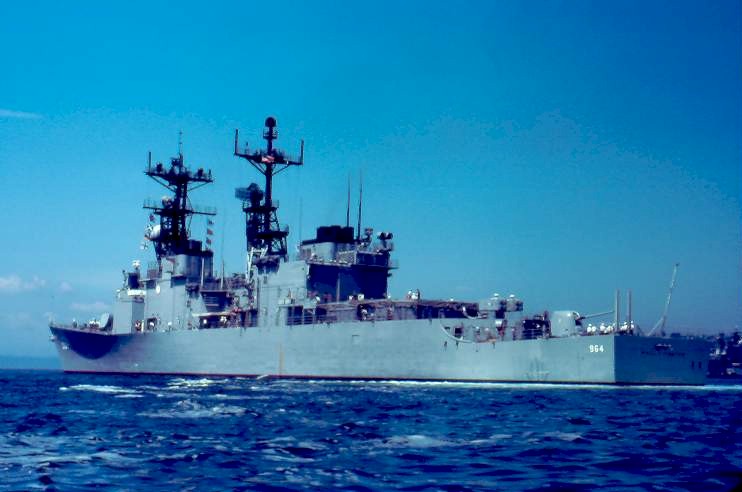
| 63k | Seatle August 1980. | Marc Piché | |
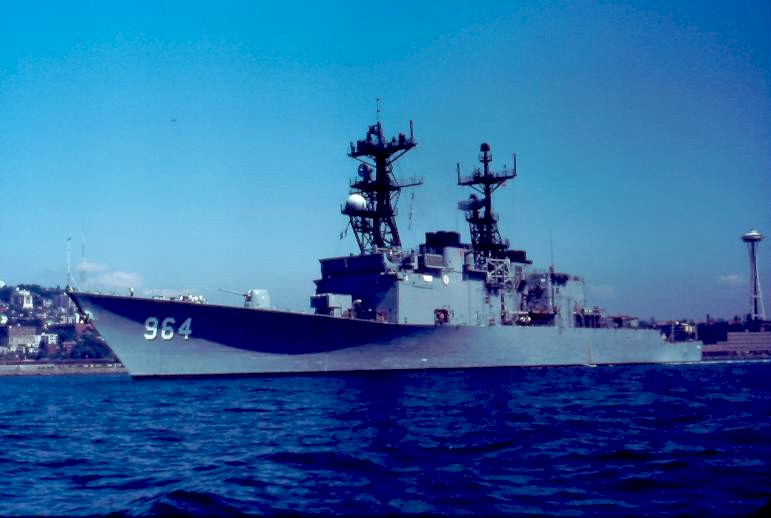
| 64k | As above. | Marc Piché | |
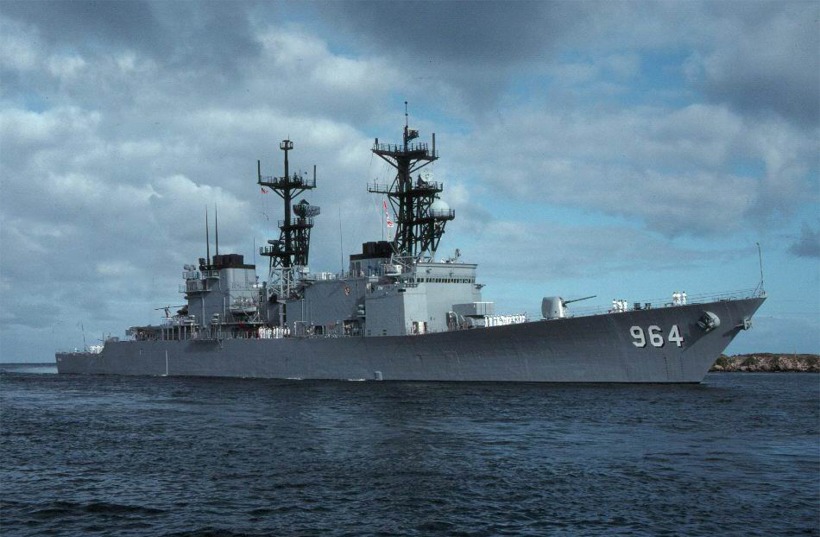
| 111k | Fremantle 1984 | Graeme D Fuller | |
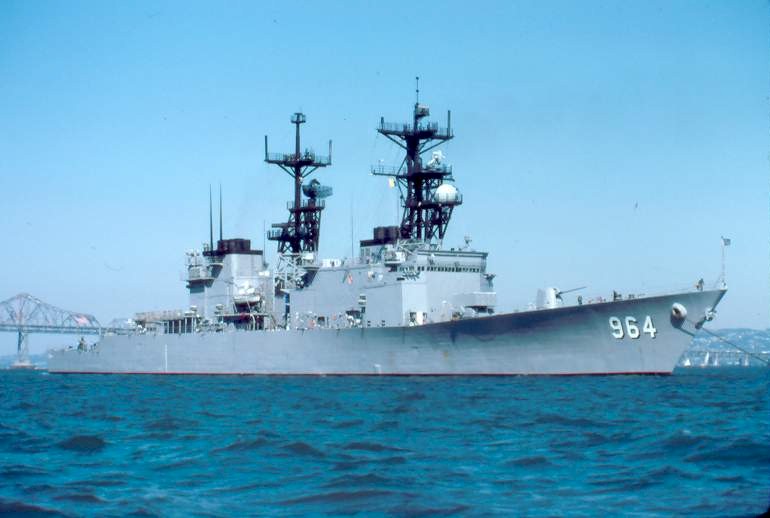
| 57k | San Francisco October 12 1985. | Marc Piché | |
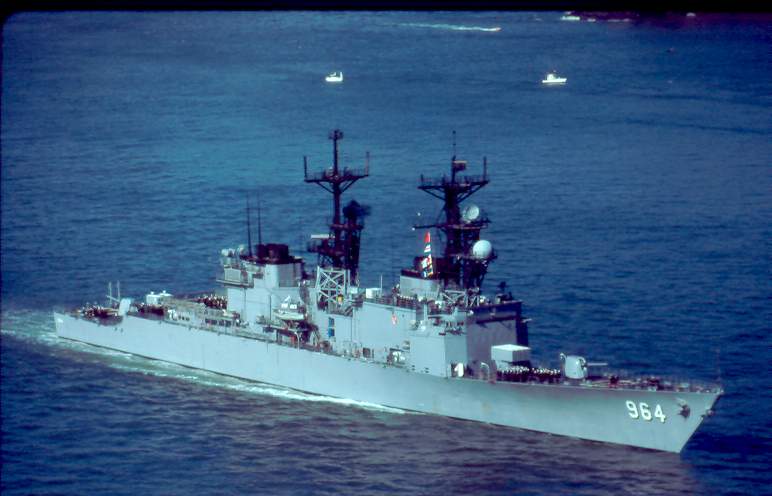
| 43k | As above. | Marc Piché | |
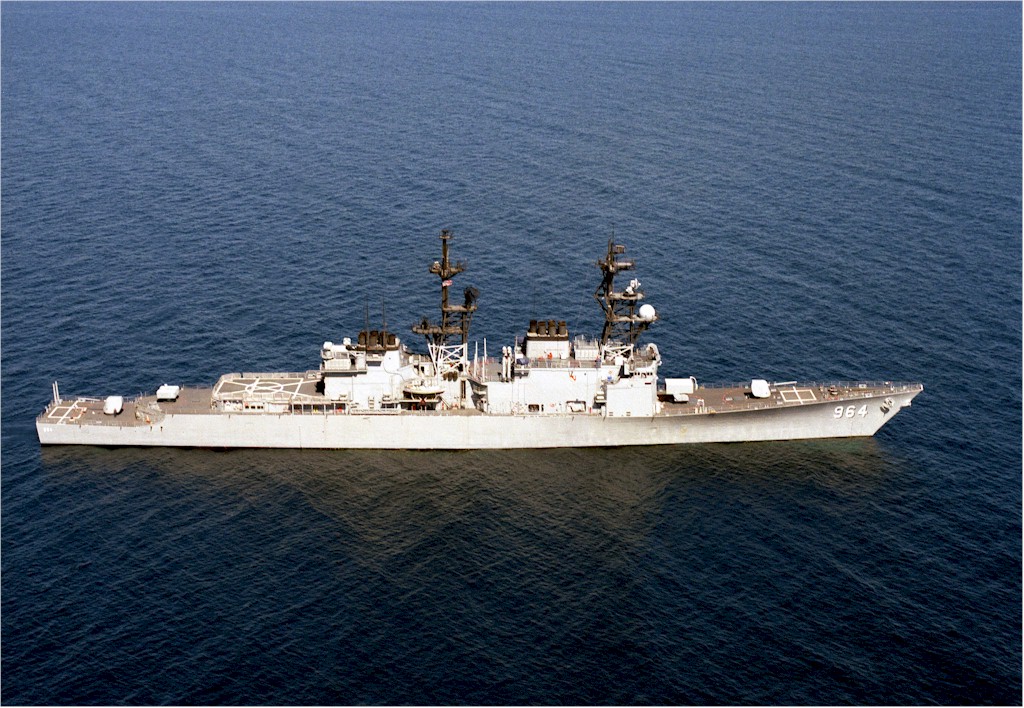
| 244k | USS Paul F. Foster (DD-964) underway on 1 April 1986, location unknown. USN photo DN-SC-90-01805. | Robert Hurst | |
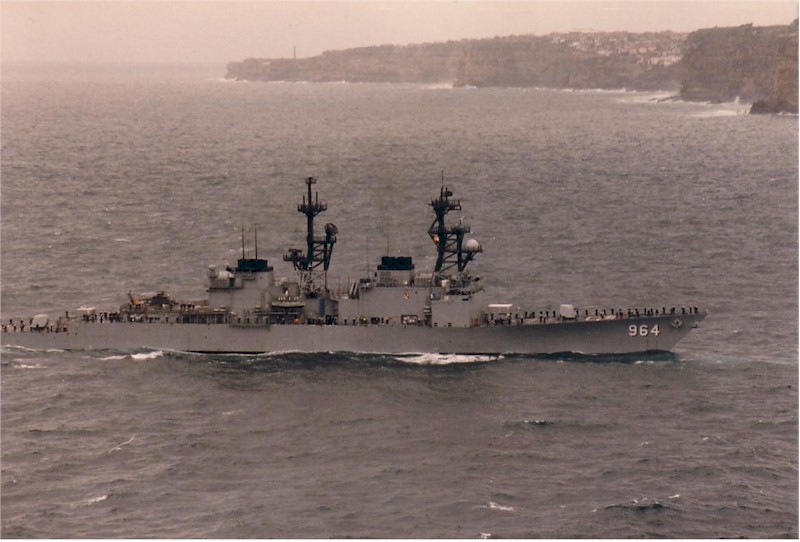
| 95k | Entering Sydney Harbor September 1986. | Paul Coleman | |
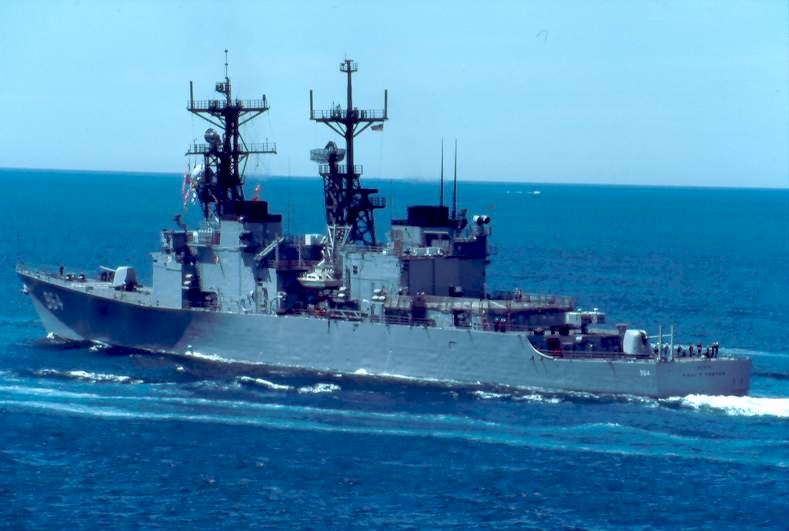
| 73k | Sydney, Australia September 1986. | Marc Piché | |
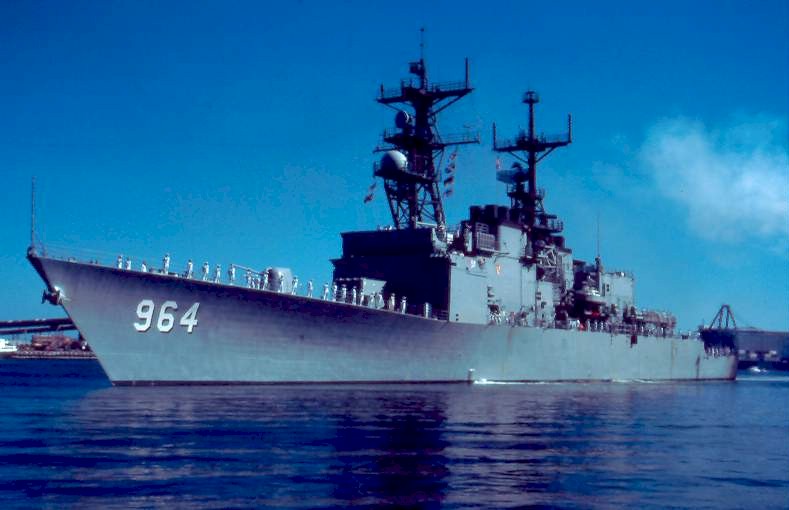
| 65k | Fremantle, Australia December 27 1986. | Marc Piché | |
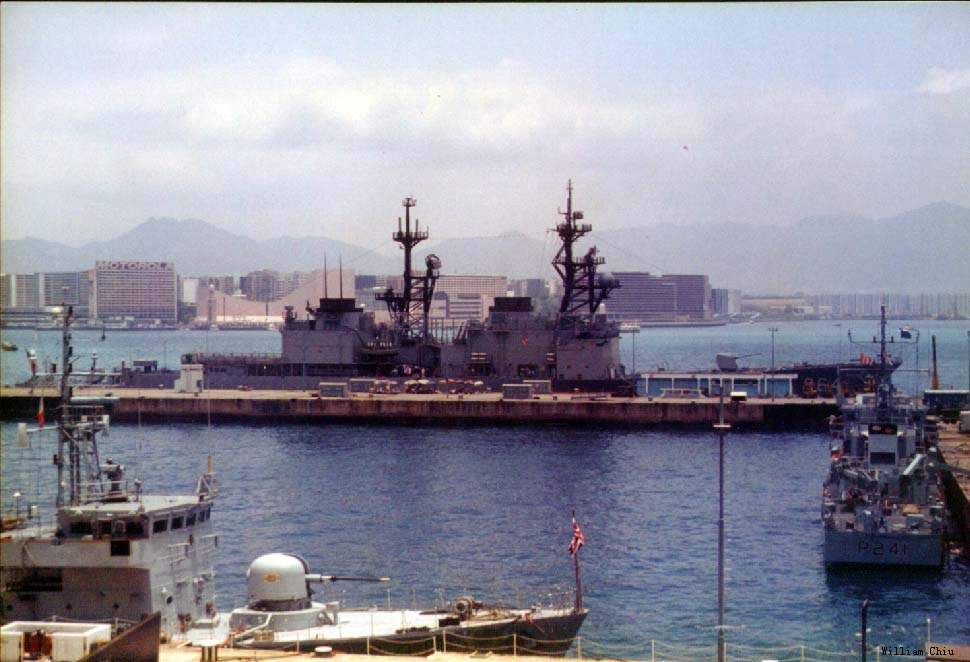
| 76k | USS Paul F. Foster in Hong Kong with fleet ships P240 Plover and P241 Starling, May 12 1991. | William Chiu | |
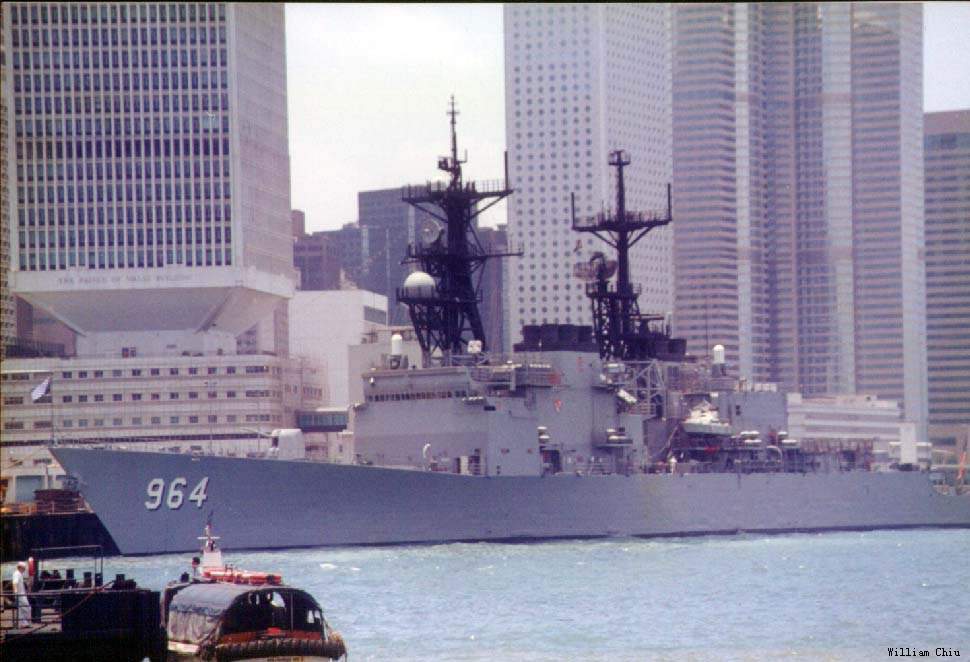
| 79k | May 12 1991 in Hong Kong Harbor. | William Chiu | |
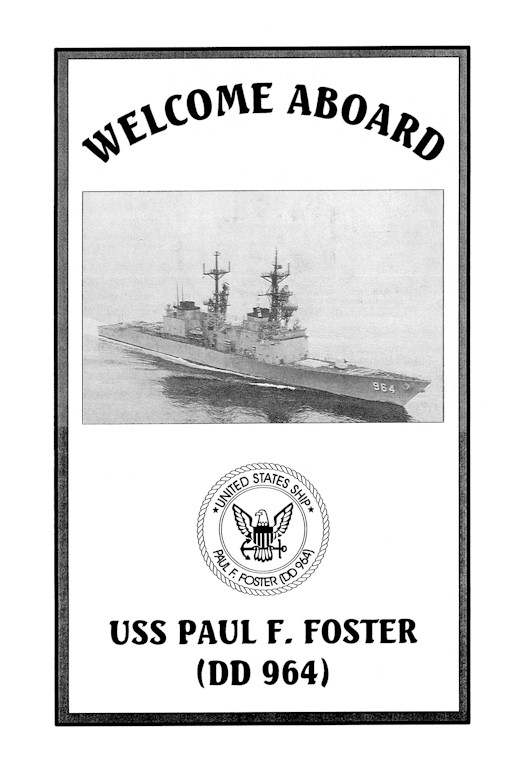
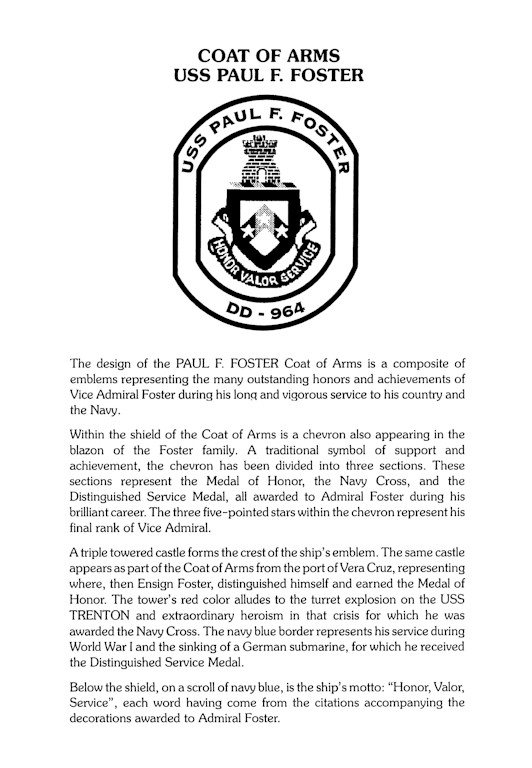
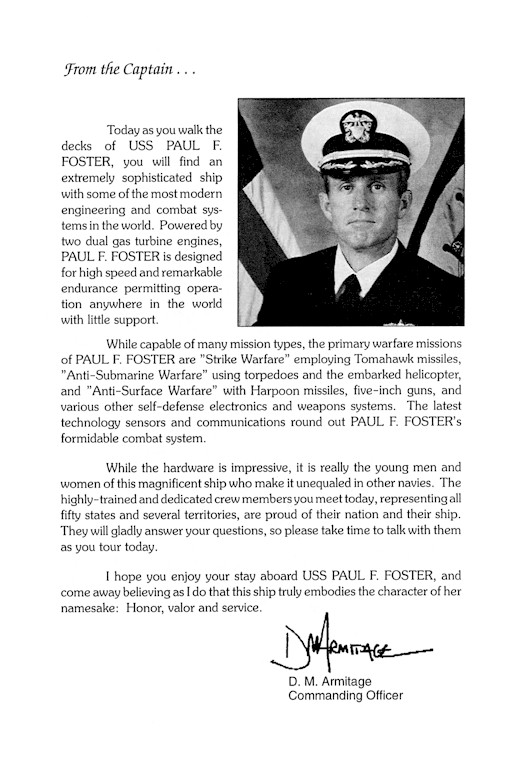
 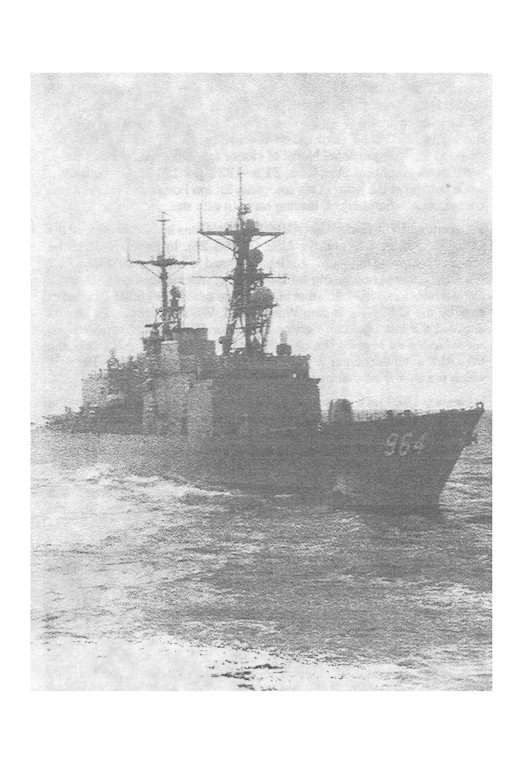
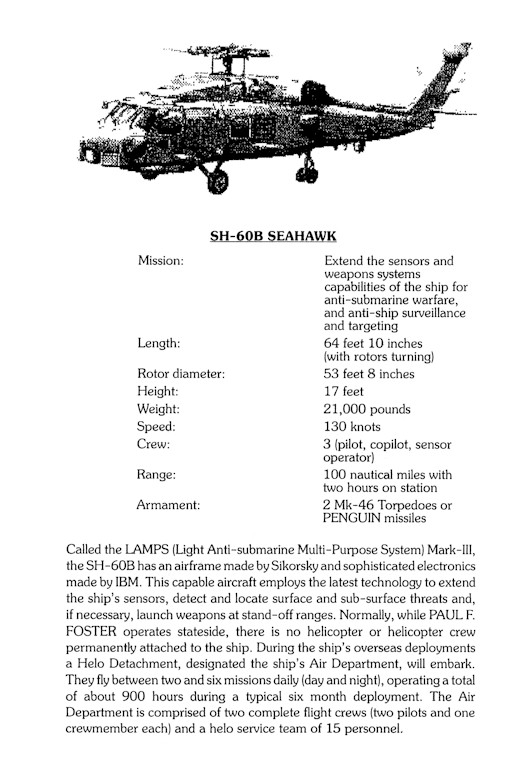
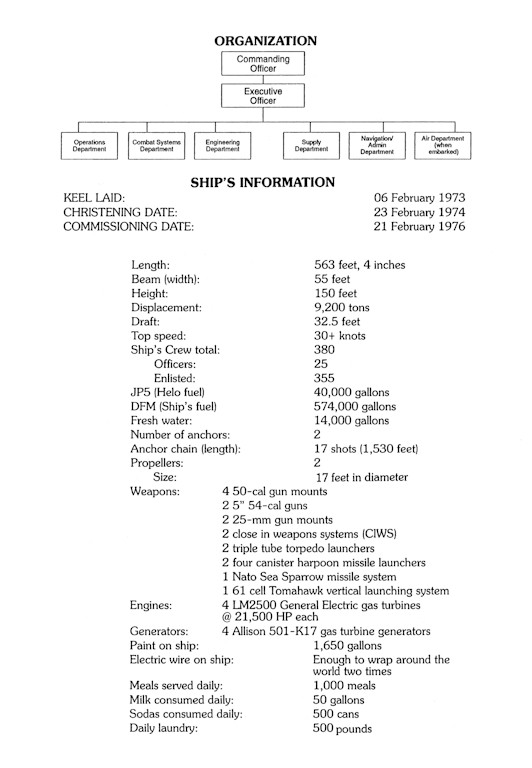 Welcome Aboard pamphlet - circa 1995 | Wolfgang Hechler | |||
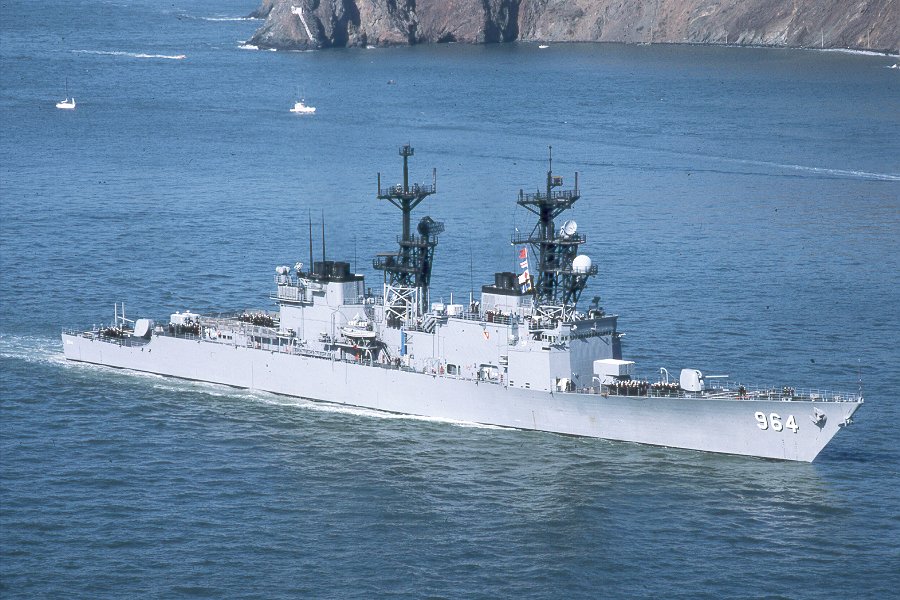
| 142k | November 1995, passing underneath the Golden Gate Bridge. | William T. Larkins/Dave Armitage | |
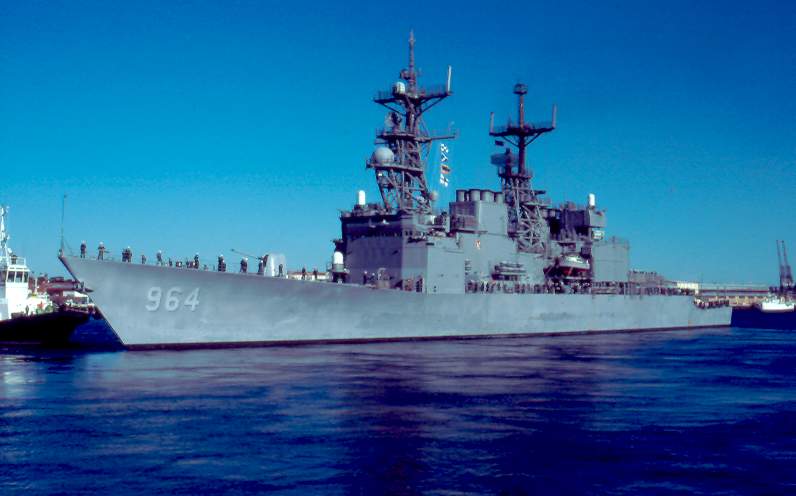
| 37k | Fremantle, Australia July 22 1997. | Marc Piché | |
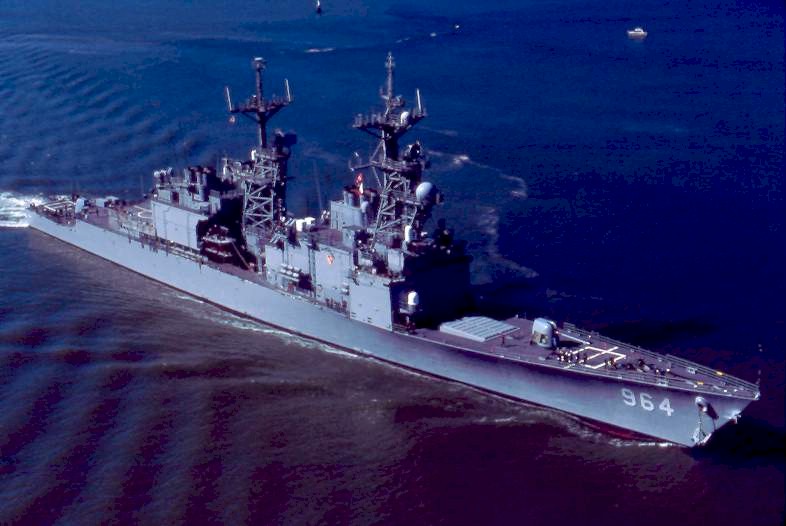
| 80k | Vancouver September 3 1999. | Marc Piché | |
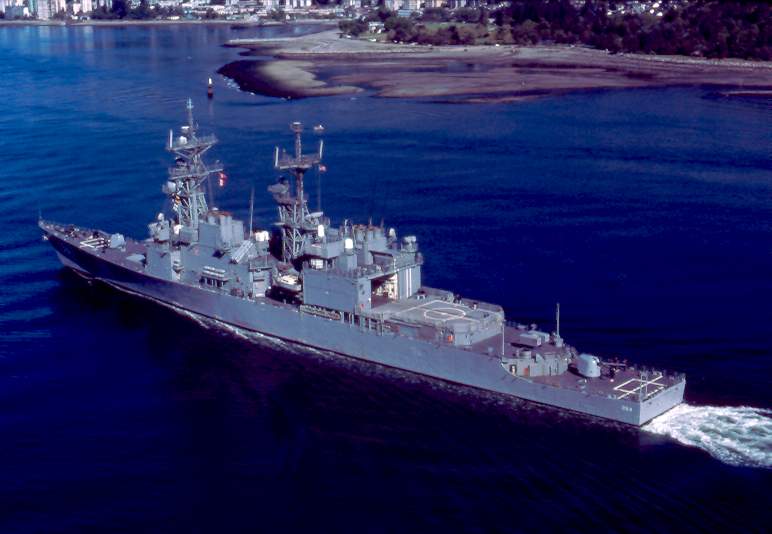
| 41k | Vancouver September 7 1999. | Marc Piché | |
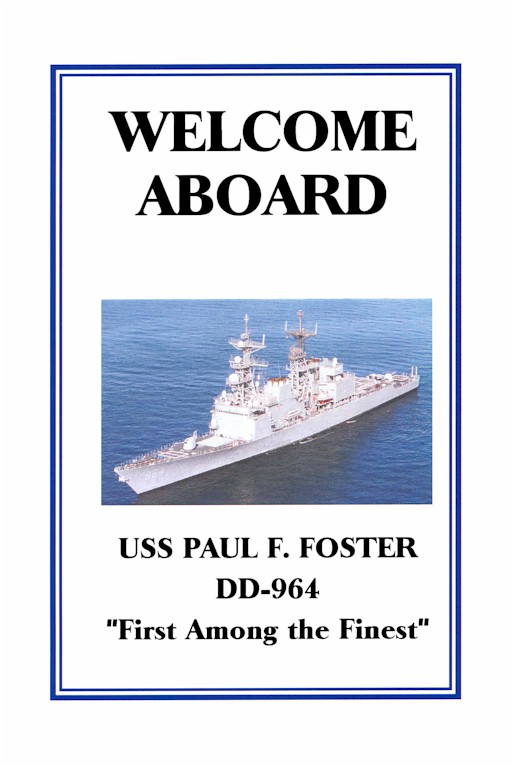
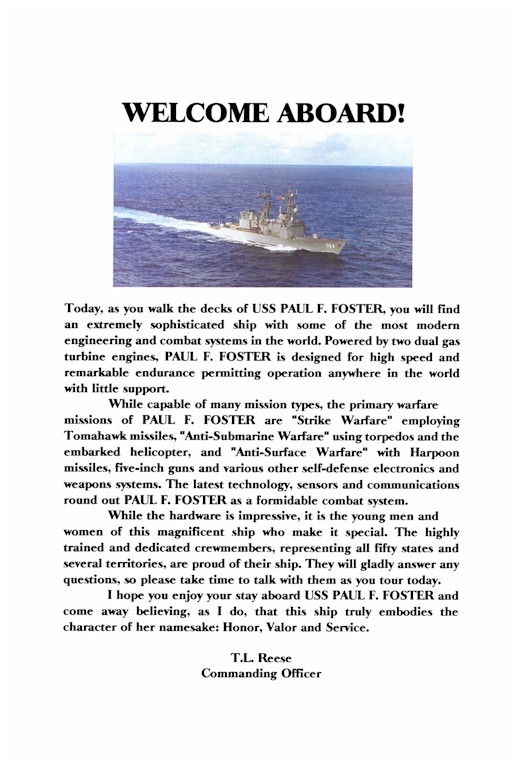
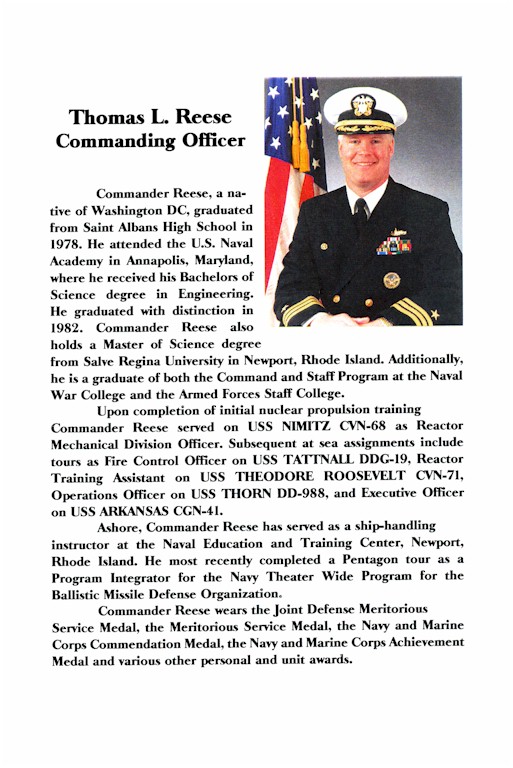
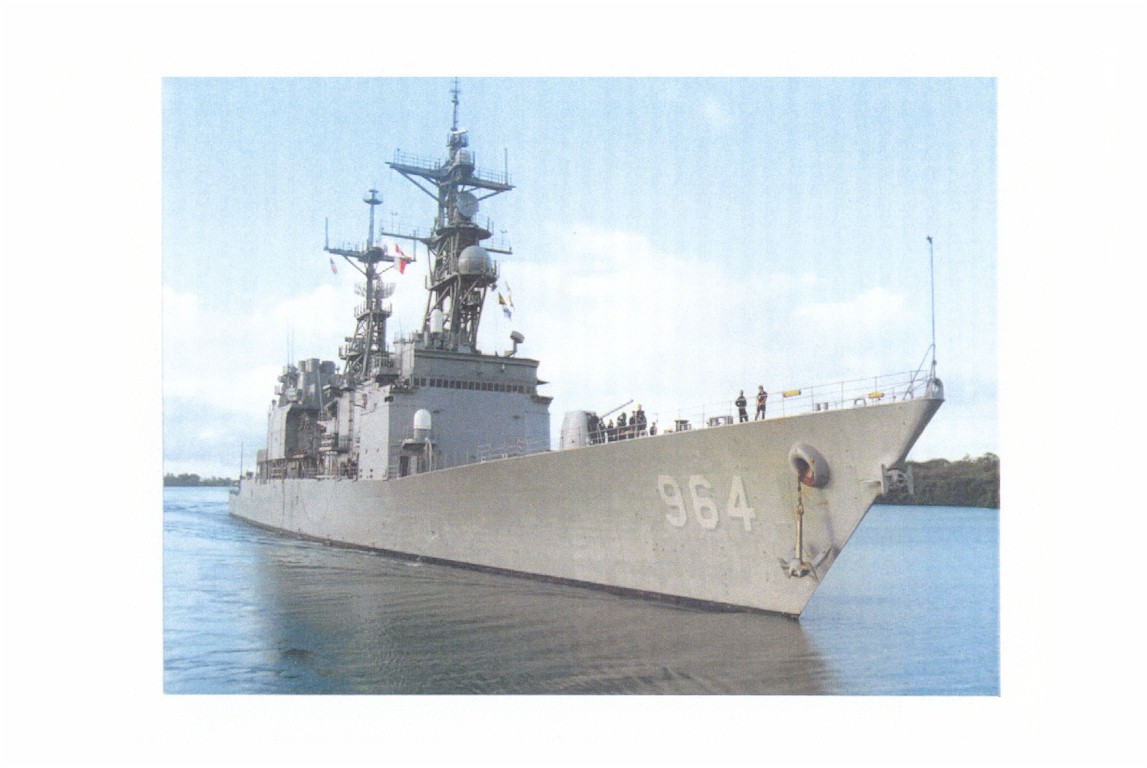
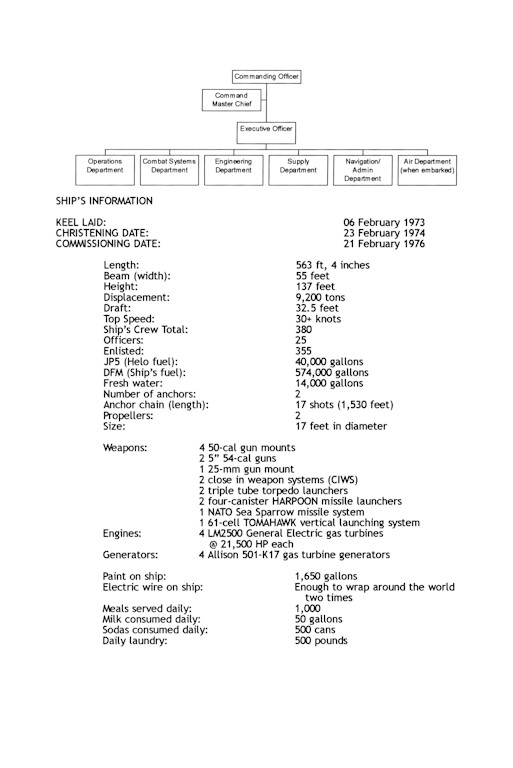
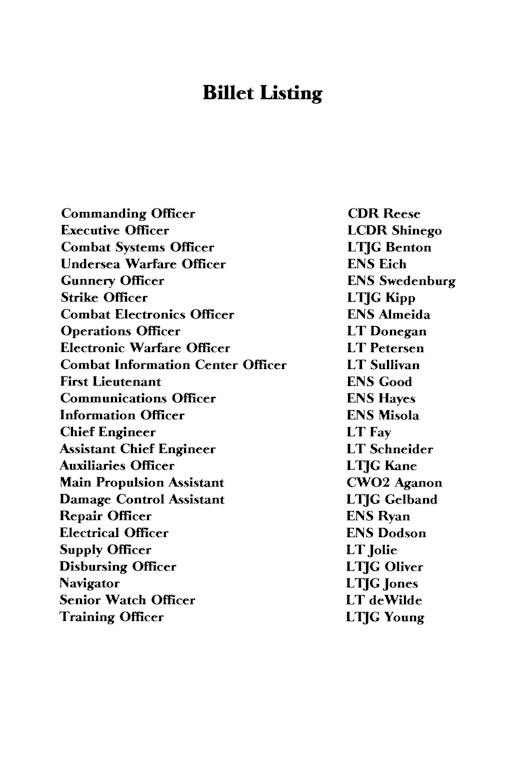
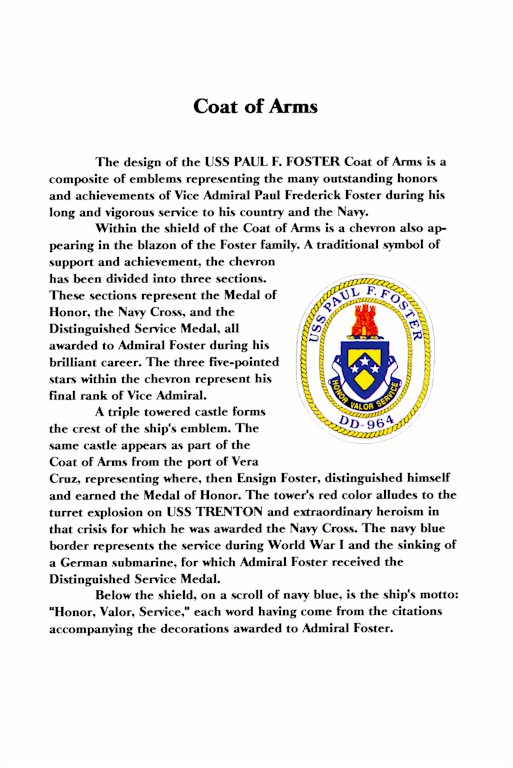
 Welcome Aboard pamphlet - circa 2000 | Wolfgang Hechler | |||
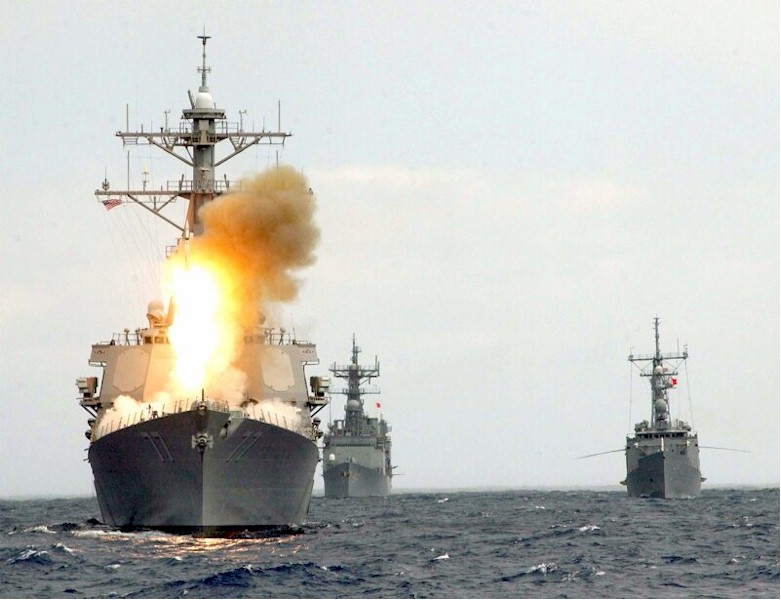
| 90k | Pacific Missile Range Facility, Kauai, Hawaii, July 6 2002, the guided missile destroyer USS O'Kane (DDG 77) launches an SM-2 Standard missile from her forward Vertical Launch System (VLS) during exercise "Rim of the Pacific" (RIMPAC) 2002. The guided missile frigate USS Crommelin (FFG 37) (right) and the Spruance-class destroyer USS Paul F. Foster (DD 964) (center) follow in formation. U.S. Navy photo by Photographer's Mate 1st Class Chris Desmond. [020706-N-5862D-090]. | Fabio Peña | |
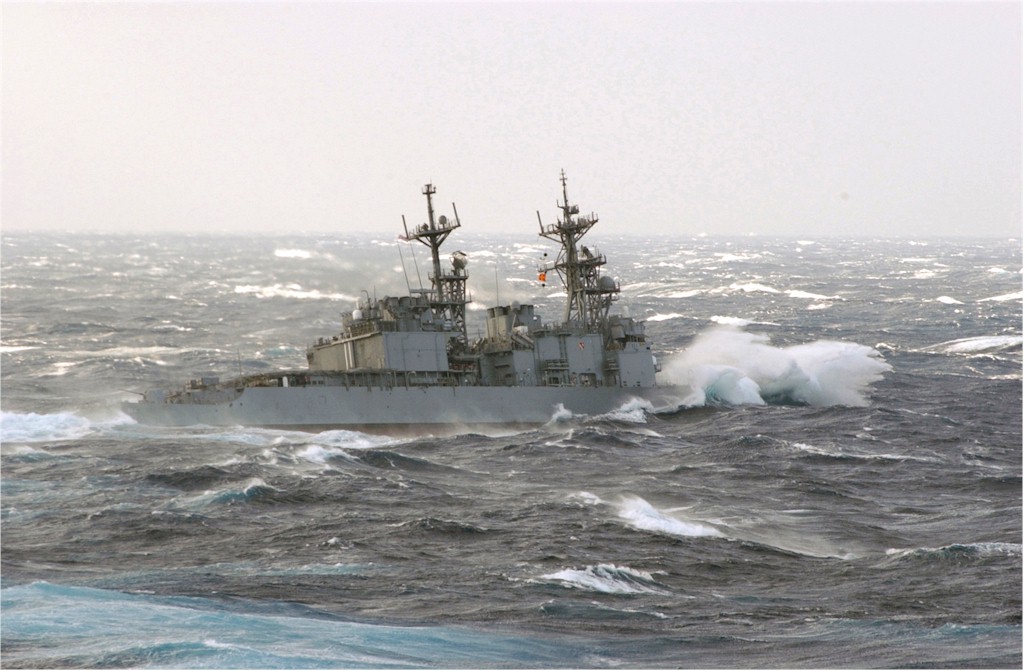
| 155k | At sea with USS Paul F. Foster (DD 964), October 29 2002, the destroyer USS Paul F. Foster turns away after an attempt to replenish fuel from the Military Sealift Command ship (MSC) USNS Rappahannock (T-AO 204). The seas were too high and conditions too rough to safely execute a scheduled replenishment at sea (RAS). Later in the day, calmer seas allowed the two ships to connect and complete their mission. U.S. Navy Photo by Photographer’s Mate 3rd Class William H. Ramsey. | Fred Weiss/Robert Hurst | |
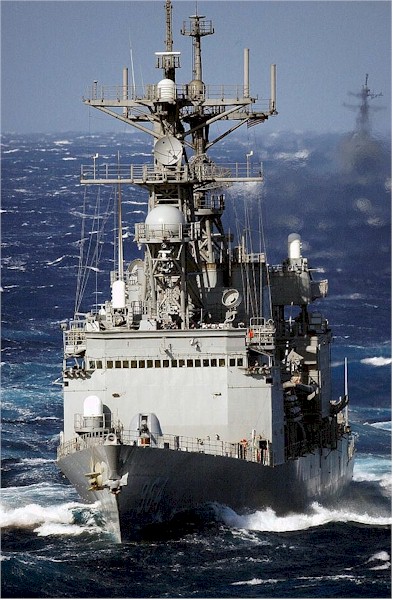
| 95k | From aboard USS Kitty Hawk (CV 63), October 29 2002, the destroyer USS Paul F. Foster (DD 964) approaches the starboard side of the Military Sealift Command ship USNS Rappahannock (T-AO 204) to take on fuel. Replenishments at sea enable Navy ships to remain deployed at sea for indefinite periods of time. U.S. Navy photo by Photographer’s Mate 3rd Class William H. Ramsey. | Fred Weiss | |
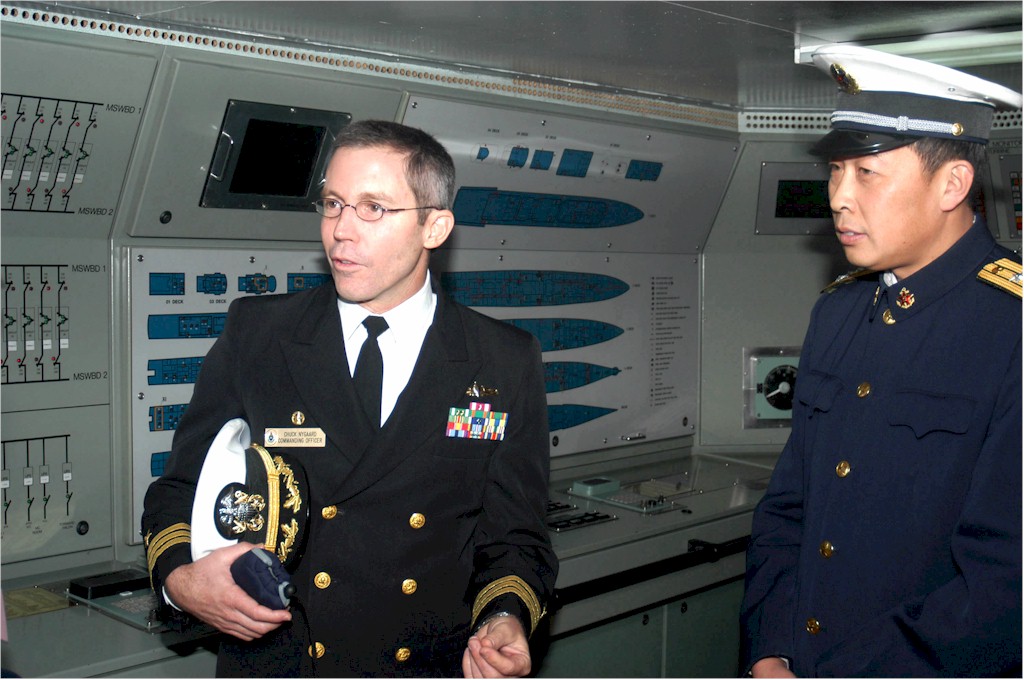
| 162k | 021125-N-1777B-002 Qingdao, China, November 25 2002, Cmdr. Chuck Nygaard Commanding Officer of the U.S. Navy’s Spruance-class destroyer USS Paul F. Foster (DD 964), asks Vice Adm. Din Yi Ping, Commander, People's Liberation Army, North Sea Fleet, about operations aboard the Chinese Destroyer Qingdao (DD 113) in the ship's central control station. Sailors from both the Paul F. Foster and Qingdao toured spaces aboard each other's ships. Paul F. Foster, homeported in Everett, Wash., is the first U.S. Navy ship to visit Mainland China since March 2001, following the downing of a U.S. Navy EP-3E “Aeries” reconnaissance aircraft in April 2001. U.S. Navy photo by Journalist 2nd Class Shawn Burns. | Bill Gonyo | |
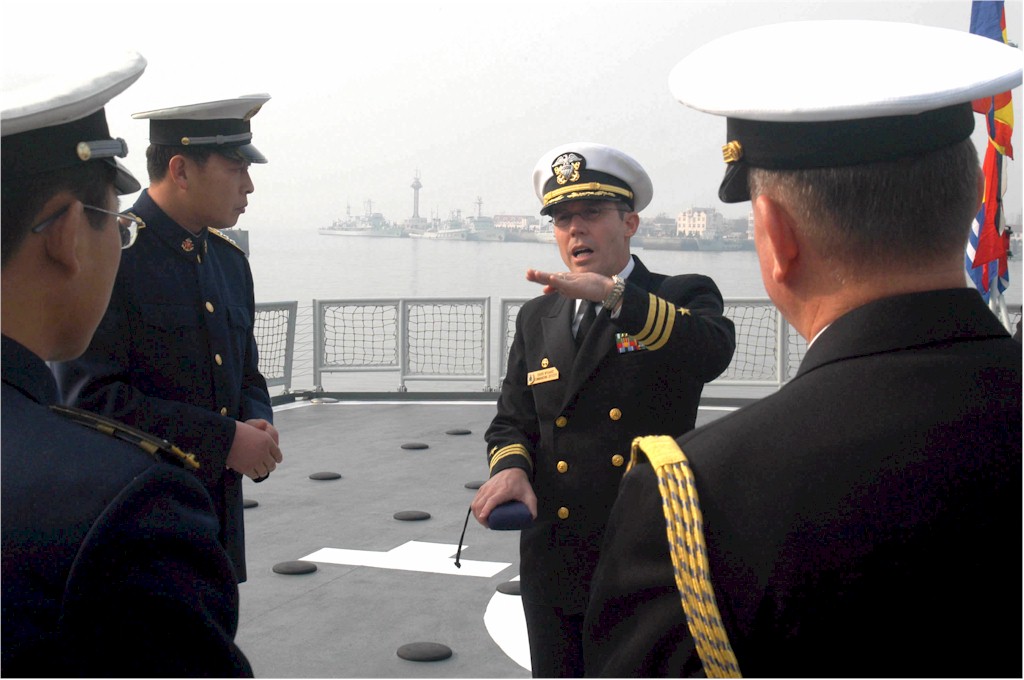
| 127k | 021125-N-1777B-003 Qingdao, China, November 25 2002, Cmdr. Chuck Nygaard (second from the right) Commanding Officer of the U.S. Navy’s Spruance class destroyer USS Paul F. Foster (DD 964), discusses flight operations with Capt. Li Yu Jie (second from the left), Commanding Officer of Qingdao (DD 113), during a tour aboard the Chinese Destroyer. Sailors from both the Paul F. Foster and Qingdao toured spaces aboard each other's ships. Paul F. Foster, homeported in Everett, Wash., is the first U.S. Navy ship to visit Mainland China since March 2001, following the downing of a U.S. Navy EP-3E “Aeries” reconnaissance aircraft in April 2001. U.S. Navy photo by Journalist 2nd Class Shawn Burns. | Bill Gonyo | |
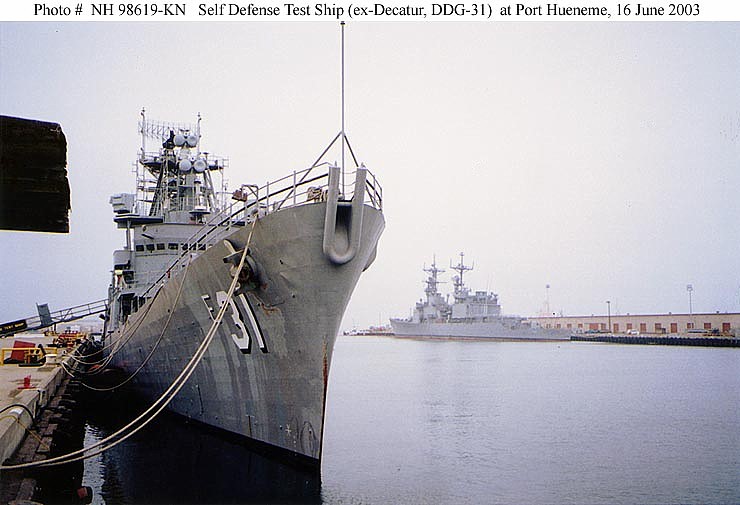
| 81k | Self Defense Test Ship (SDTS), formerly USS Decatur (DDG-31) At Port Hueneme, California, 16 June 2003. The decommissioned destroyer Paul F. Foster (DD-964), in the distance, was then being prepared to become the new SDTS, replacing the ex-Decatur. Note the towing fitting installed on the ship's bow. Photographed by Frank V. Thompson. Courtesy of Frank V. Thompson, 2003. U.S. Naval Historical Center Photograph. | Fred Weiss | |
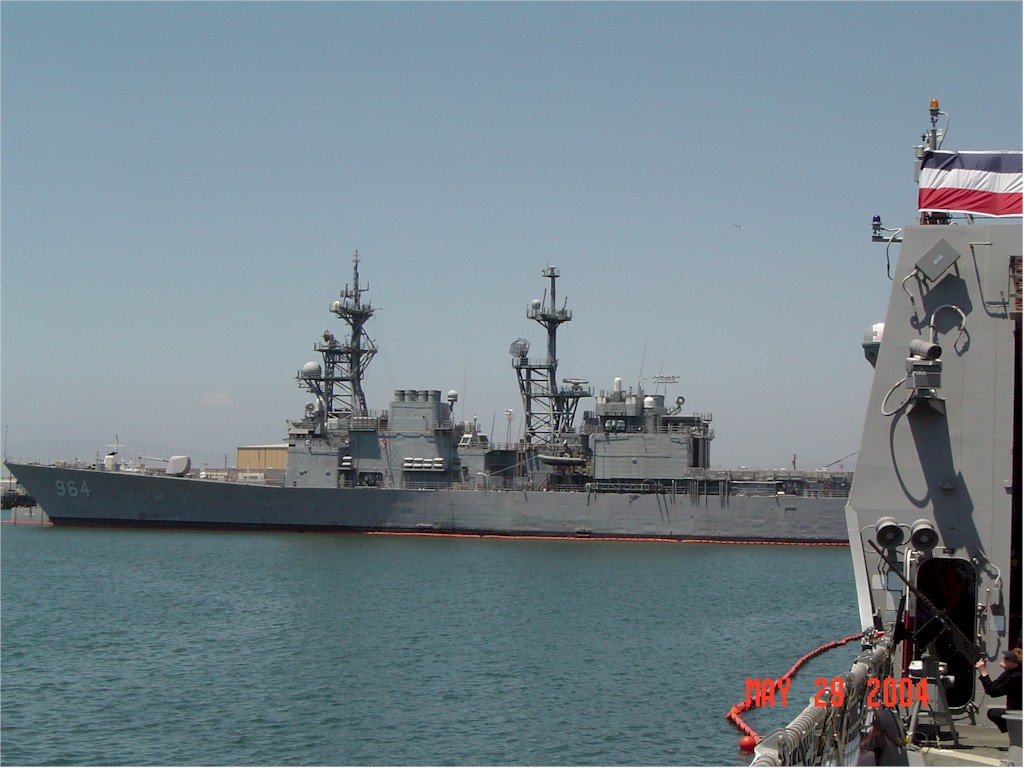
| 148k | At Port Hueneme, California, May 29 2005. | Steve Singlar | |
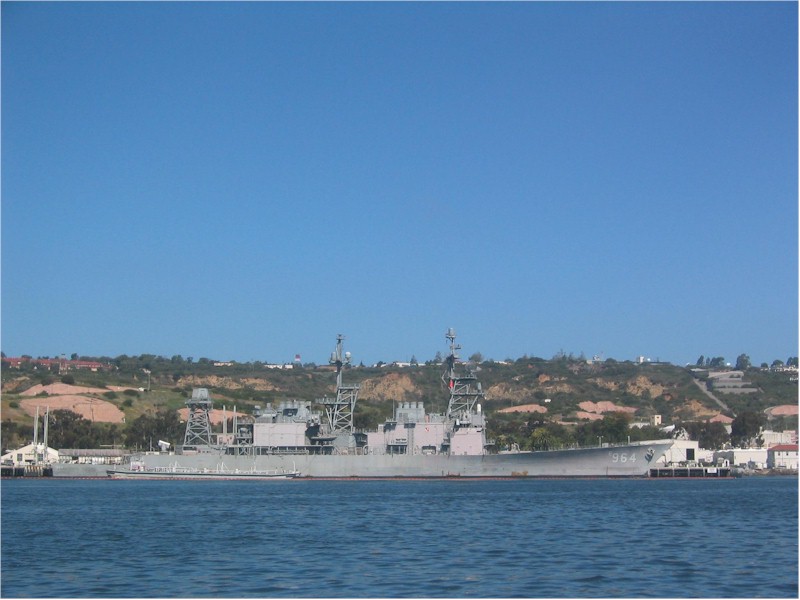
| 89k | Self Defense Test Ship (SDTS), formerly USS Paul F. Foster (DD-964) at Bravo Pier, San Diego Bay, May 11 2006. | David Berg | |
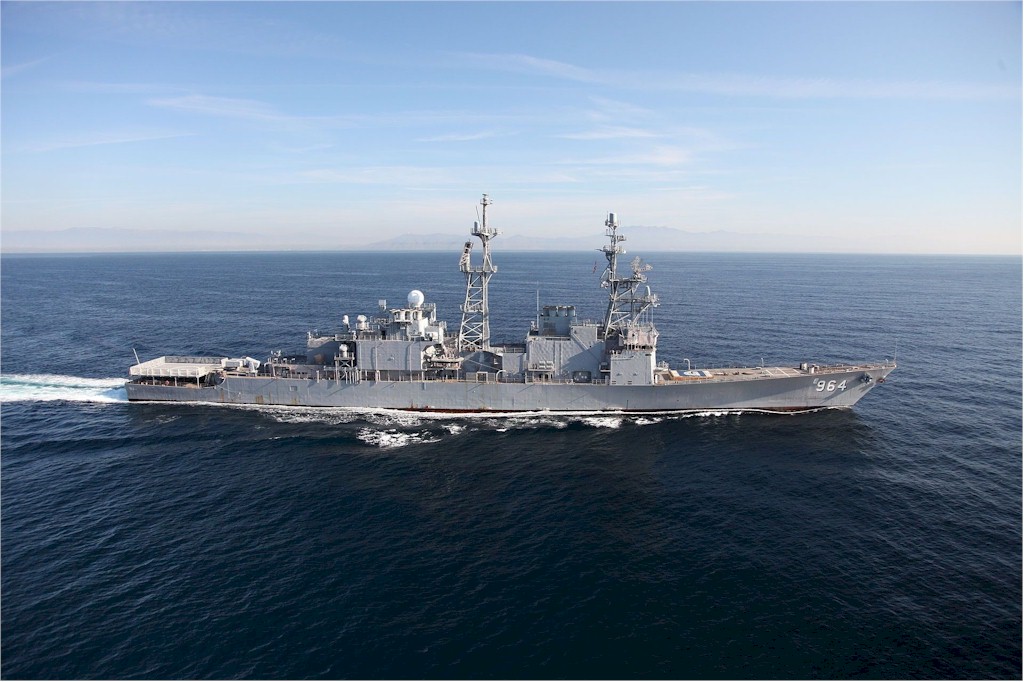
| 156k | Navy’s Self Defense Test Ship, the former USS Paul Foster in 2011. US Navy Photo. Lockheed refurbished a Mk 41 Vertical Launch System cell for the test, combined the 500 nautical mile range LRASM with an additional booster and tied it to a Tactical Tomahawk Weapon Control System (TTWCS) for guidance – all installed on Navy’s Self Defense Test Ship. The Foster is currently at Port Hueneme, Calif., serving as EDD 964 as the Navy’s new Self Defense Test Ship (SDTS). | Tommy Trampp | |
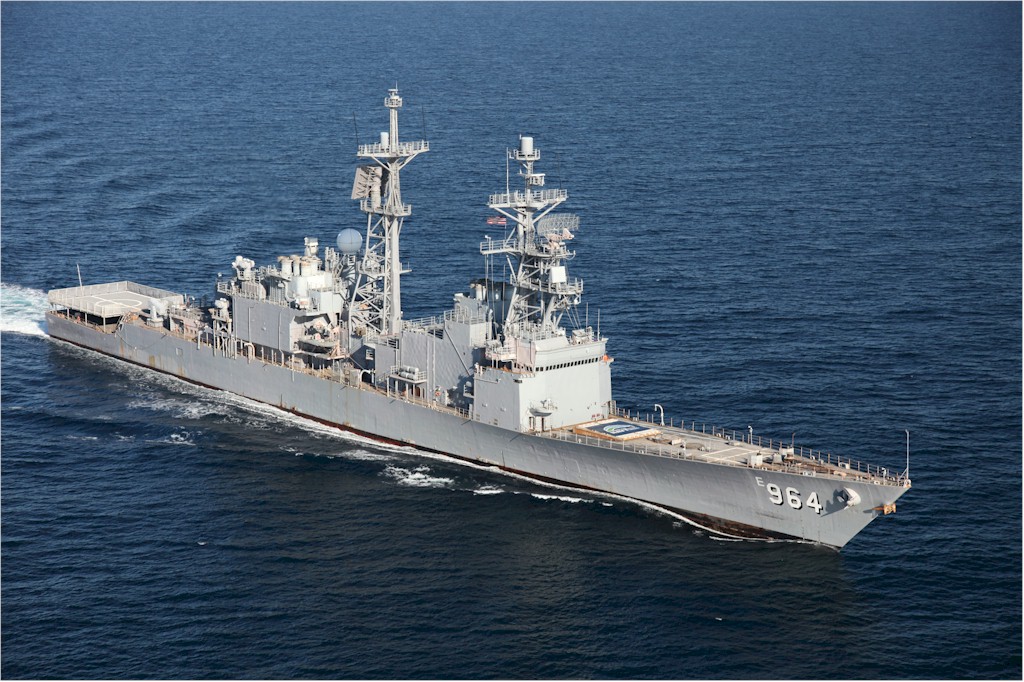
| 222k | 111117-N-ZZ999-142. Pacific Ocean, November 17 2011, the decommissioned Spruance-class destroyer ex-Paul F. Foster (EDD-964) conducts a successful demonstration of shipboard alternative fuel use while underway in the Pacific Ocean on a 50-50 blend of an algae-derived, hydro-processed algal oil and petroleum F-76. Paul F. Foster has been reconfigured as the Self-Defense Test Ship to provide the Navy an at-sea, remotely controlled, engineering test and evaluation platform without the risk to personnel or operational assets. U.S. Navy photo by Charlie Houser. | Philip Sims | |
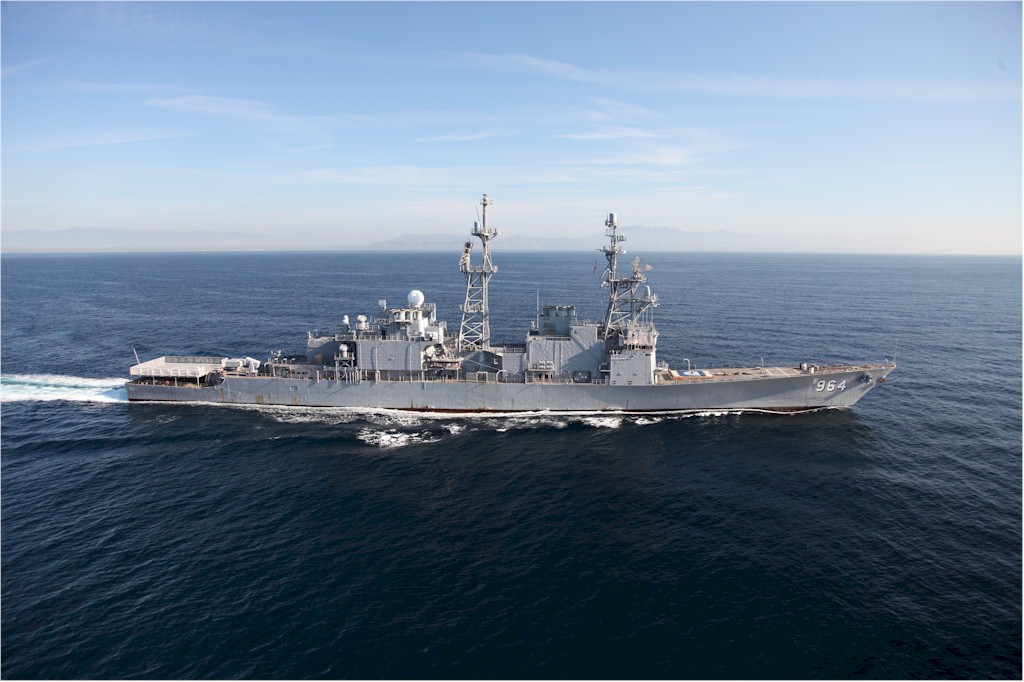
| 142k | As above. | Wolfgang Hechler | |
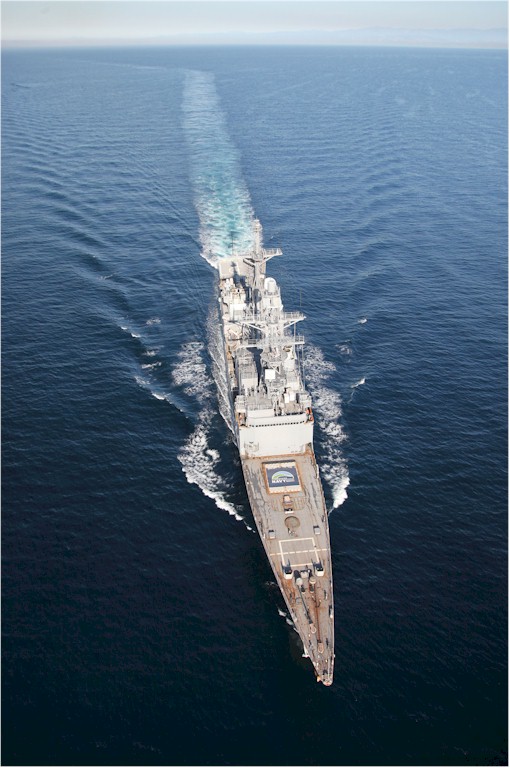
| 100k | As above. | Wolfgang Hechler | |
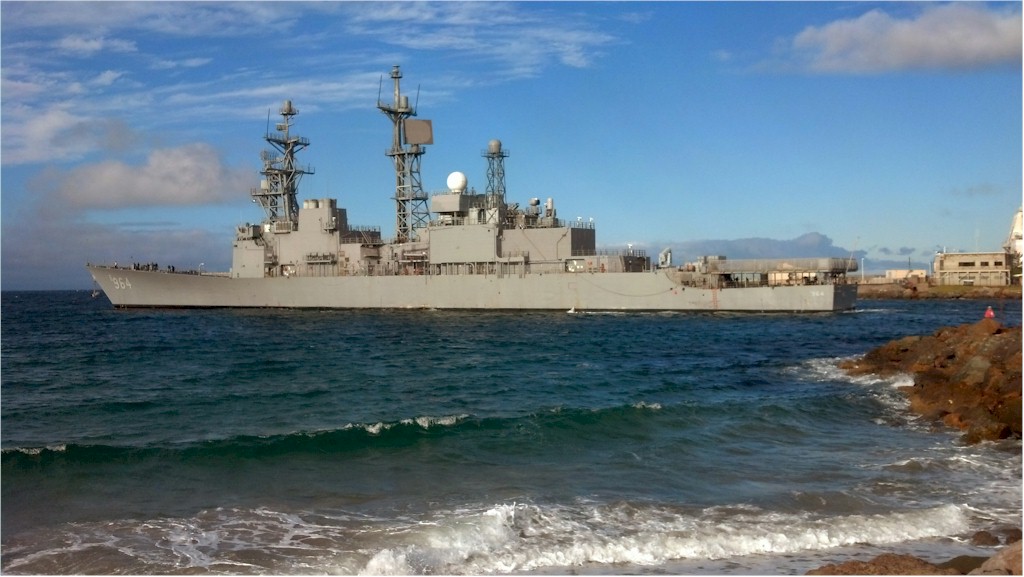
| 134k | Leaving Port Hueneme on November 21 2013. | Carl Friedlander | |
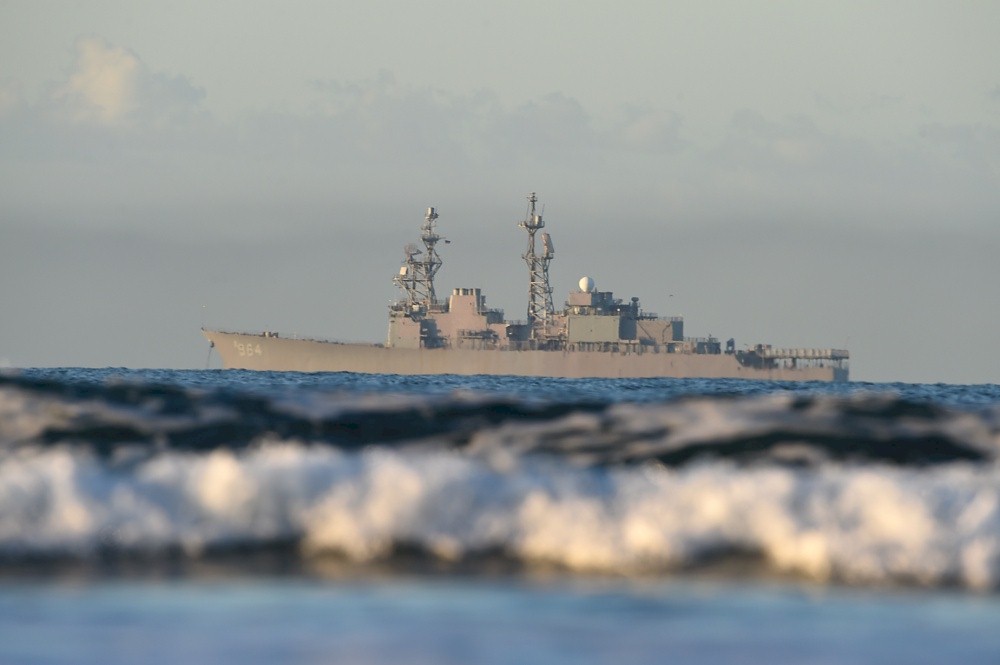
| 74k | 151105-N-AV746-215. 5 Coronado, Calif., November 5 2015 the ex-Paul F. Foster anchored off the southern coast of California. Paul F. Foster serves as the new Self Defense Test Ship for Naval Surface Warfare Center. U.S. Navy photo by Mass Communication Specialist 2nd Class Timothy M. Black. | Ron Reeves | |
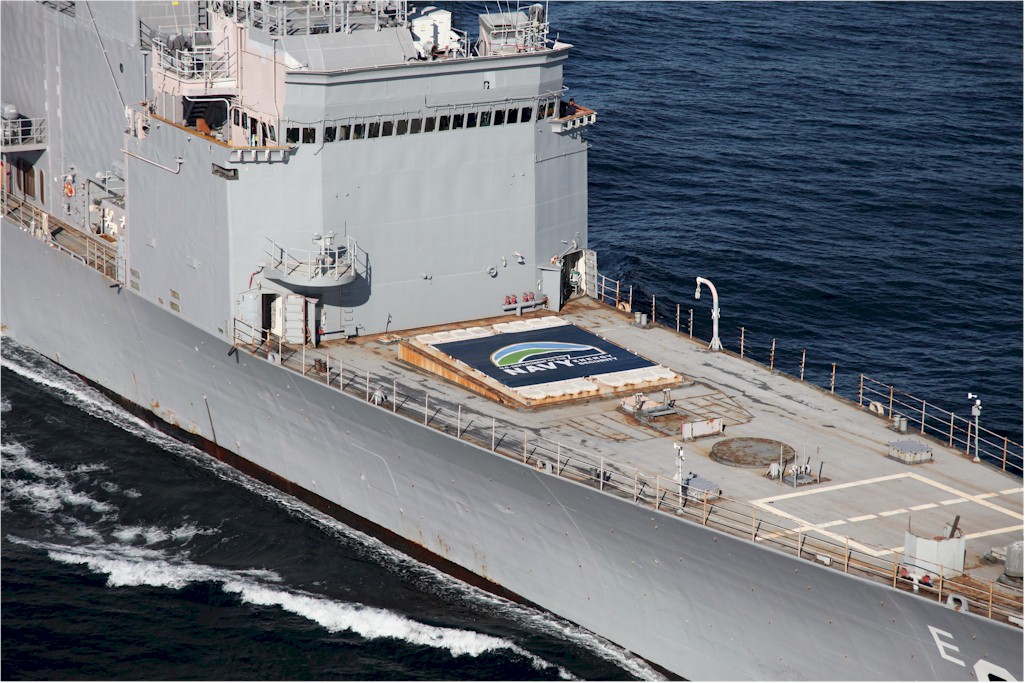
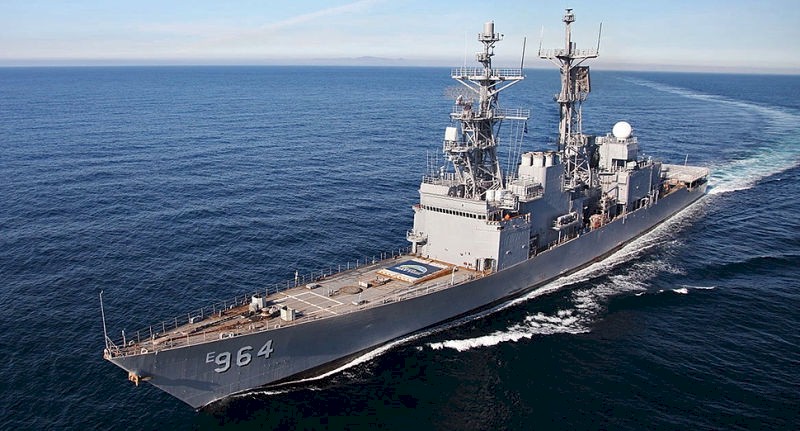
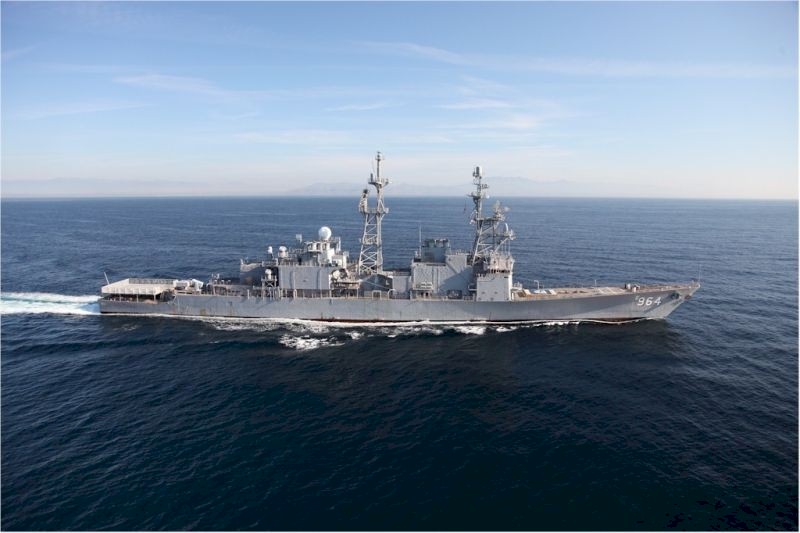
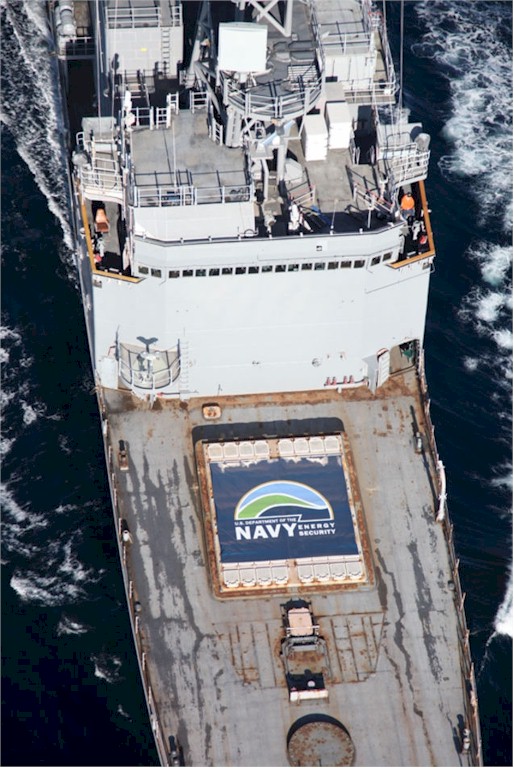
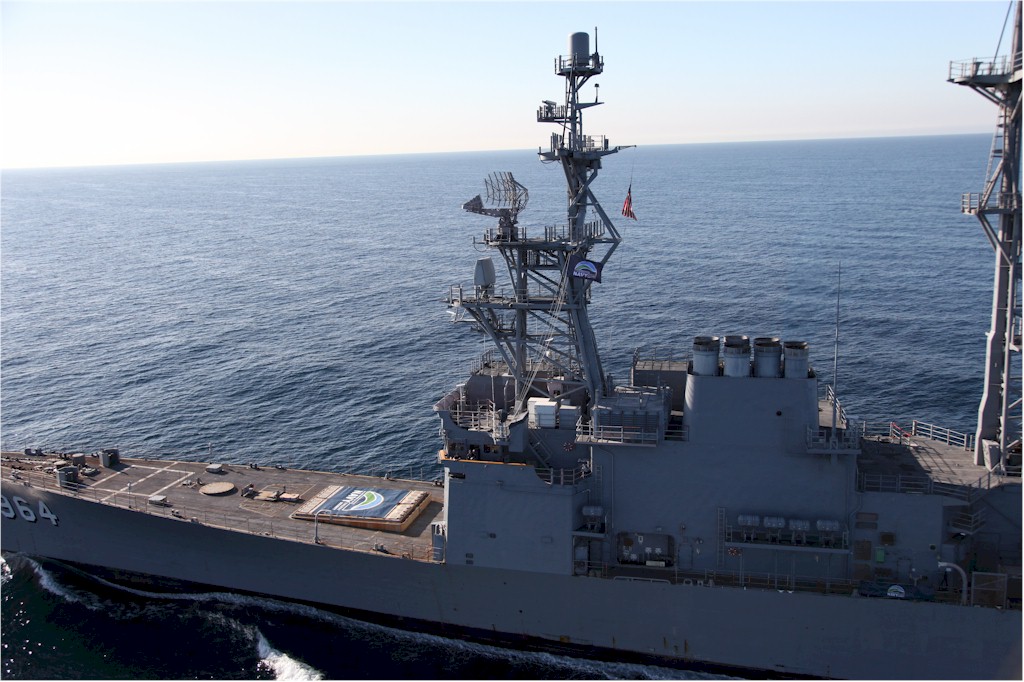 A Series of views of the Foster after her decommissioning. | Ron Reeves | |||
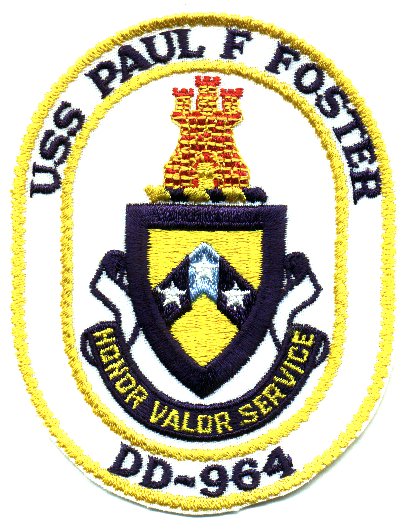
| 88k | Ship's patch | Mike Smolinski | |
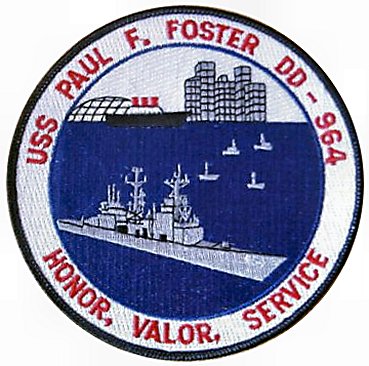
| 44k | Ship's patch | Mike Smolinski | |
CDR George Edward Sullivan III   Feb 21 1976 - Apr 7 1978

CDR Albert Lee Kaiss    Apr 7 1978 - May 11 1980

CDR Theodore Charles (Ted) Lockhart    May 11 1980 - May 17 1982 (later RADM)

CDR Laurence Hay Turner Jr.    May 17 1982 - Jun 15 1984

CDR Raymond Paul Conrad    Jun 15 1984 - Nov 1 1986

CDR Robert Benell Danberg    Nov 1 1986 - Feb 11 1989

CDR Timothy Michael Ahern    Feb 11 1989 - Feb 23 1991

CDR Edward Joseph Kujat    Feb 23 1991 - Nov 28 1992

CDR Kim Smith Buike    Nov 28 1992 - Aug 6 1994

CAPT David Alan Gelenter    Aug 6 1994 - Aug 4 1995

CDR David Michael Armitage    Aug 4 1995 - Jun 17 1997

CDR Thomas Scott Abernethy    Jun 17 1997 - Nov 6 1998

CDR Thomas John Strei Jr.    Nov 6 1998 - Jun 5 2000

CDR Thomas Langhorne Reese    Jun 5 2000 - Feb 11 2002

CDR John Charles (Chuck) Nygaard    Feb 11 2002 - Mar 14 2003
| Back To The Main Photo Index | To The Destroyer Index Page |
