Photographic History of the United States Navy
ARCHIVE
| NavSource Main Page | FAQ | Contact us | Search NavSource |
| |
NavSource Naval History Photographic History of the United States Navy |
DESTROYER ARCHIVE |
| Click On Image For Full Size Image |
Size | Image Description | Contributed By And/Or Copyright |
|
|---|---|---|---|---|
 |
59k | David Glasgow Farragut, born at Campbell's Station, near Knoxville, Tenn., 5 July 1801, entered the Navy as a midshipman 17 December 1810. When only 12 years old, he was given command of a prize ship taken by Essex, and brought her safely to port. Through the years that followed, in one assignment after another he showed the high ability and devotion to duty which was to allow him in the Civil War to make an overwhelming contribution to victory and to write an immortal page in the history of not only the United States Navy but of military service of all times and nations. In command of the West Gulf Blockading Squadron, with his flag in Hartford he disproved the theory that forts ashore held superiority over naval forces, when in April 1862 he ran past Forts Jackson and St. Philip and the Chalmette batteries to take the great city and port of New Orleans (a decisive event in the war) and later that year passed the batteries defending Vicksburg. Port Hudson fell to him 9 July 1863, and on 5 August 1864 he won a great victory in the Battle of Mobile Bay, passing through heavy minefields (the torpedoes of his famous quotation) as well as the opposition of heavy batteries in Forts Morgan and Gaines to defeat the squadron of Admiral Franklin Buchanan. His country honored its great sailor by creating for him the rank of Admiral, never before used in the United States Navy. Admiral Farragut's last active service was in command of the European Squadron with Franklin as his flagship, and he died at Portsmouth, N.H., 14 August 1870. | Bill Gonyo | |
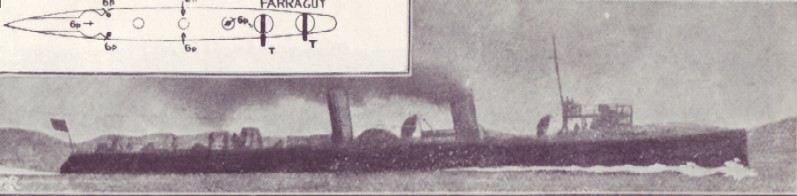 |
37k | Undated, location unknown. Photo from Jane's Fighting Ships 1914. | Robert Hurst | |
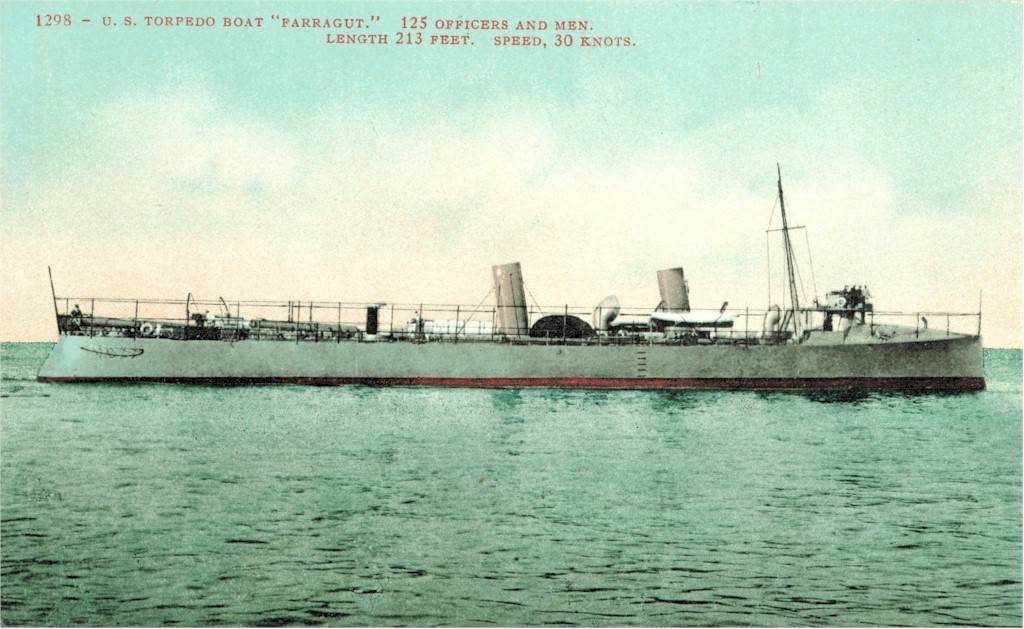 |
181k | Post card with no date or location from the collection of Raymond Strout. | Jonathan Eno | |
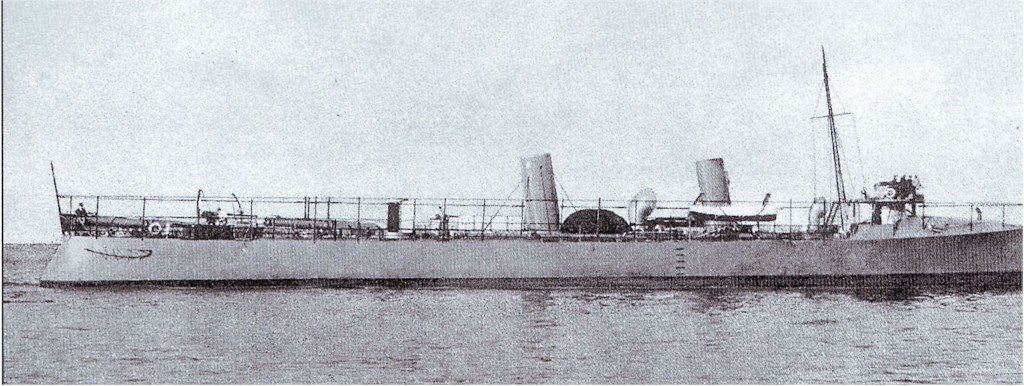 |
139k | Undated, USS Farragut (Torpedo Boat # 11), location unknown. Photo source unknown. image and text from Building The Mosquito Fleet: The U.S. Navy's First Torpedo Boats by Richard V. Simpson. | Robert Hurst | |
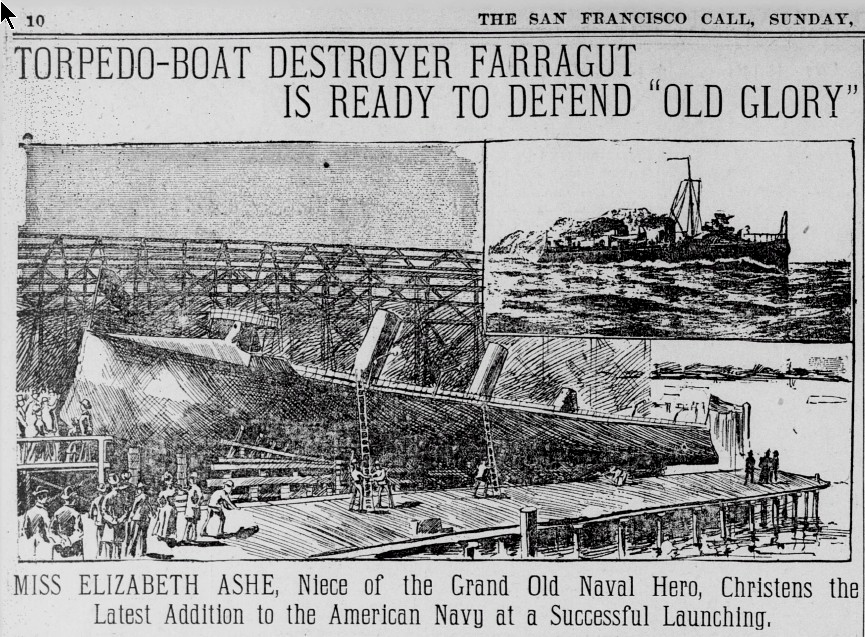 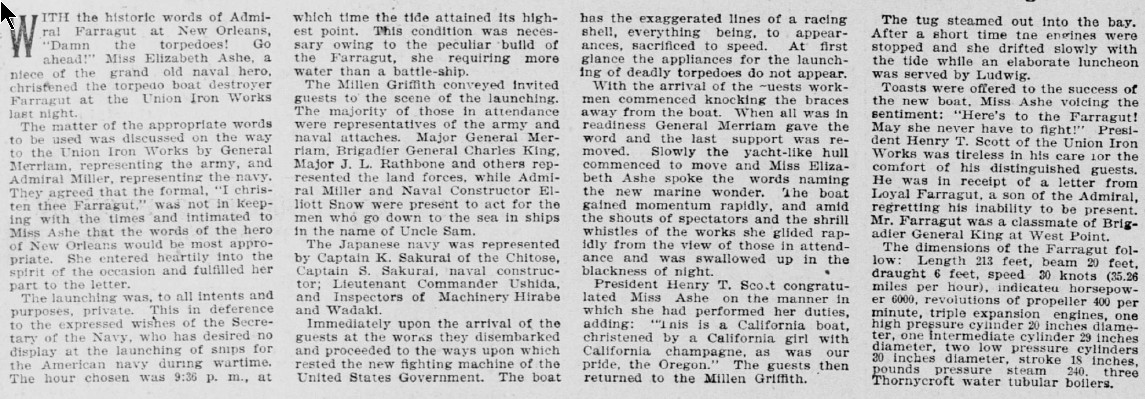 |
258k 200k | Newspaper clipping describing the Christening date Jul 17 1898. | Mike Mohl | |
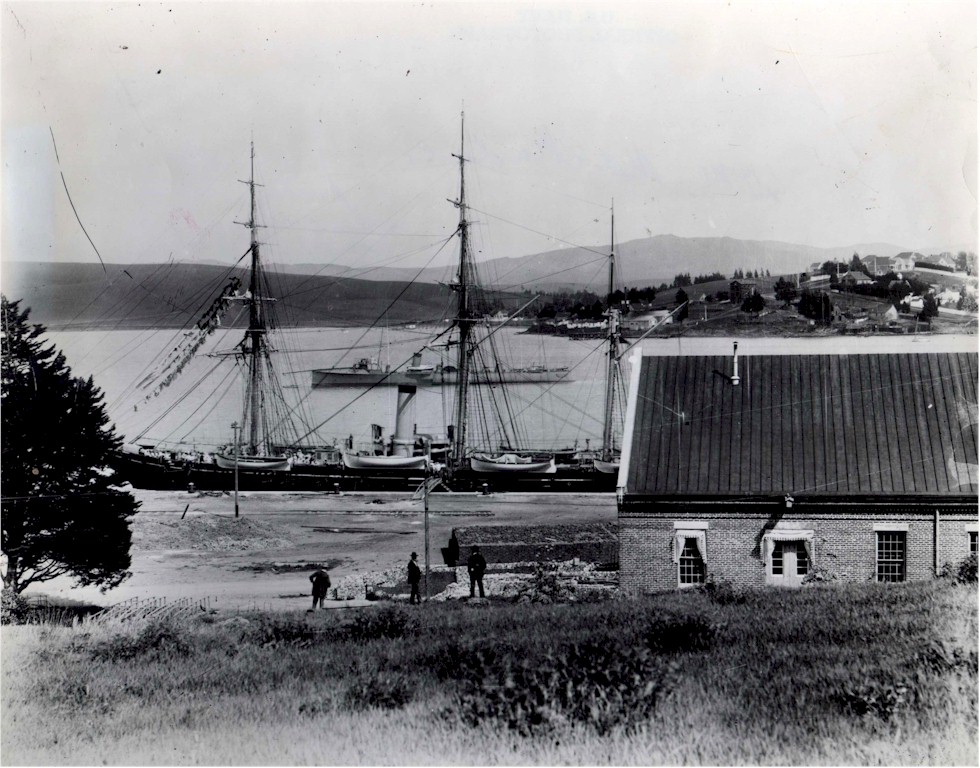 |
206kk | USS Adams is at the wharf and USS Farragut (TB-11) is at a buoy in the Mare Island Channel, circa 1898 - 1899. | Darryl Baker | |
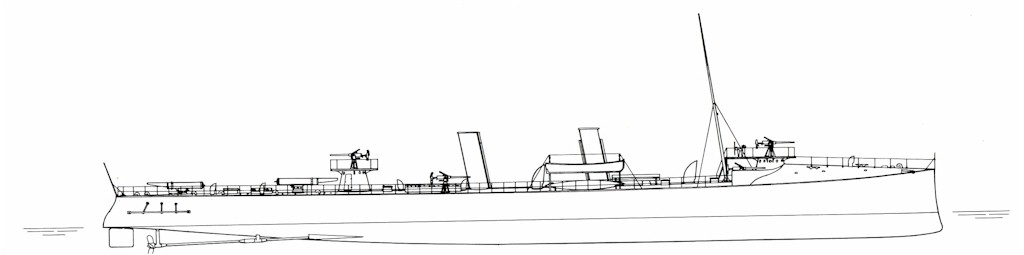 |
26k | A line drawing by A. D. Baker III of the torpedo boat USS Farragut (Torpedo boat # 11) as she appeared in 1898. Often referred to as a destroyer in contemporary references, due to heavy gun armament of six 6 pdr (57 mm) Q.F. guns and only two 18 in torpedo tubes. Only U.S. torpedo boat and destroyer with a "ram" bow profile. Scanned from U.S. Destroyers: An Illustrated Design History by Norman Friedman. | Robert Hurst | |
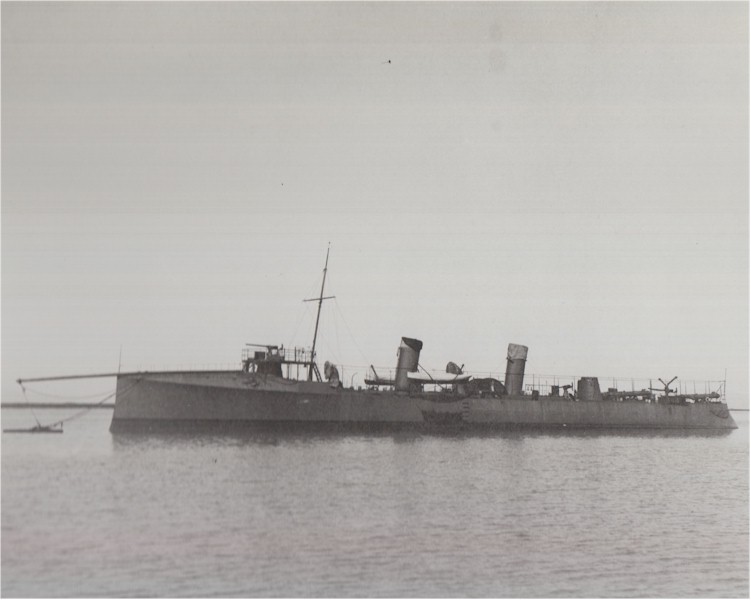 |
55k | NHC photo 71750. Off Mare Island Navy Yard circa 1899. Courtesy of the San Francisco Maritime Museum, 1970. | Terry Miller, Executive Director, Tin Can Sailors Inc. | |
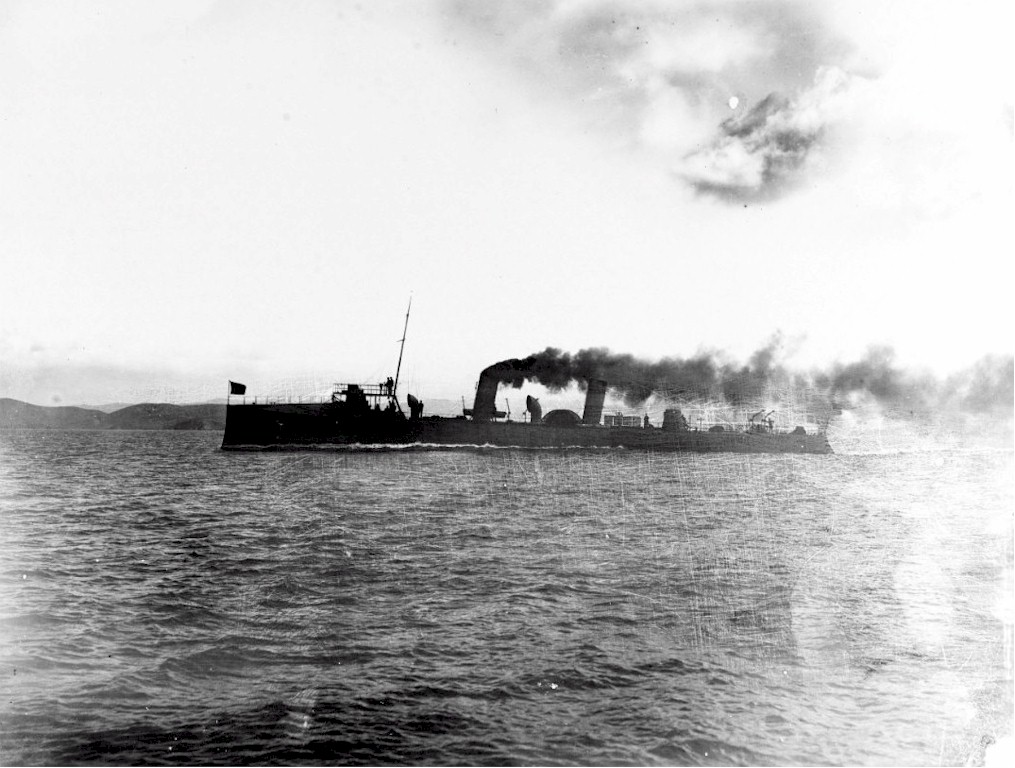 |
104k | USS Farragut (TB-11) running acceptance trials in San Francisco Bay, about 1899. Source: Naval History and Heritage Command, Photo No. NH 66727. | Mike Green | |
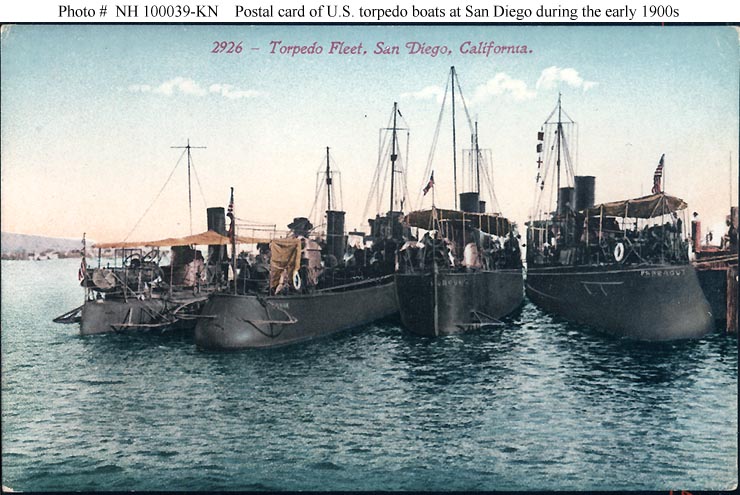 |
97k | Photo #: NH 100039-KN. "Torpedo Fleet, San Diego, California" photograph taken during the early 1900s, published on a color-tinted postcard at about that time by Edward H. Mitchell of San Francisco, California. Present are (from left to right); USS Davis (Torpedo Boat # 12); USS Rowan (Torpedo Boat # 8); USS Goldsborough (Torpedo Boat # 20); and USS Farragut (Torpedo Boat # 11). Courtesy of R.D. Jeska, 1984. U.S. Naval Historical Center Photograph. | NHC | |
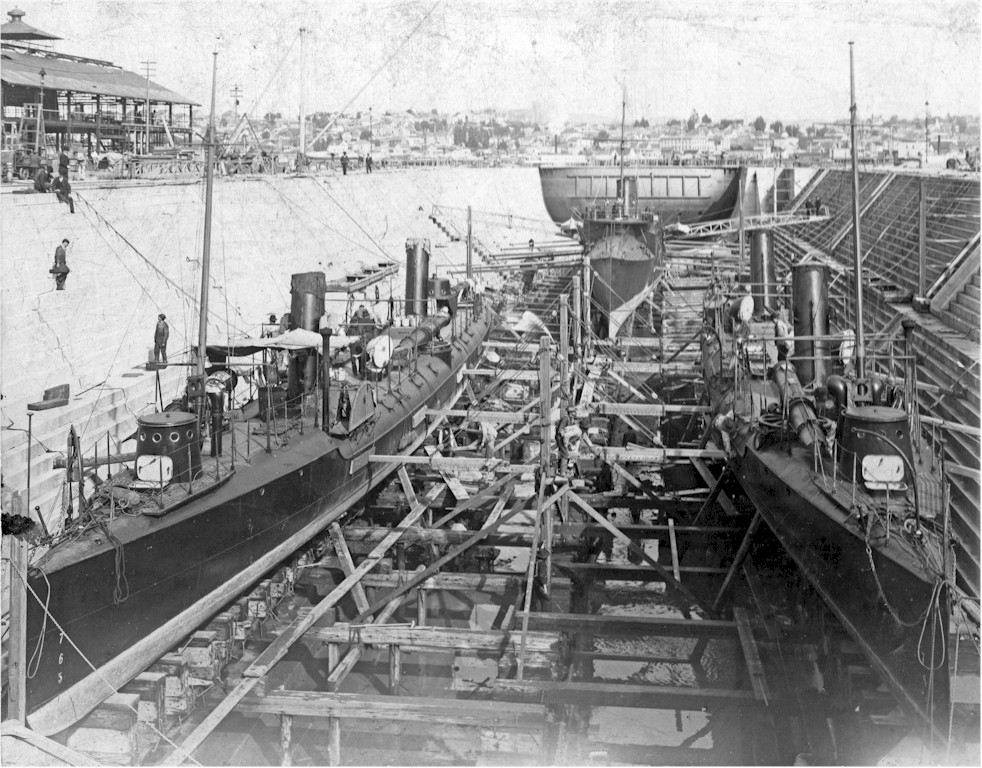 |
245k | USS Davis (TB 12), USS Fox (TB 13), and USS Farragut (TB 11) in dry dock #1 at Mare Island between 8 and 12 Feb. 1901. | Darryl Baker | |
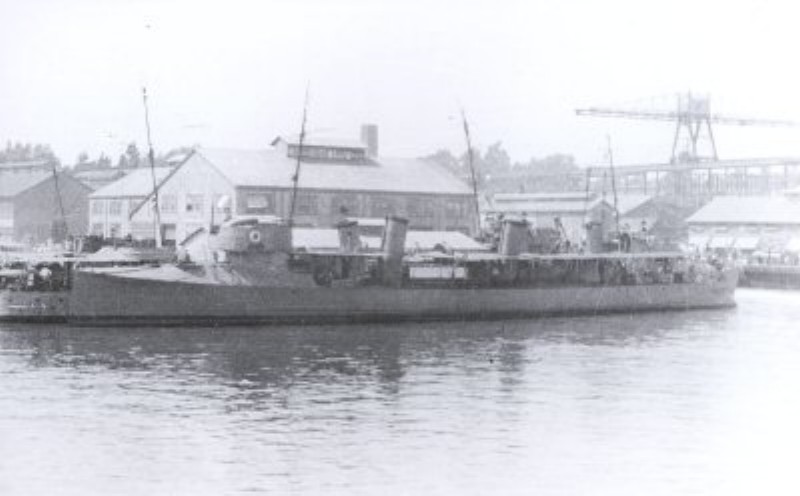 |
52k | USS Farragut (TB-11) moored at Mare Island Navy Yard after 01 November 1906 (the date the cantilever crane in the right background was installed). The other torpedo boat inboard could be Davis (TB-12) or Fox (TB-13). | Robert Hurst / Darryl Baker | |
 |
262k | Photo from a collection of photos called "California Reception to the Fleet 1908". The photo shows USS Perry (DD-11), USS Preble (DD-12) and USS Farragut (TB-11). | Darryl Baker | |
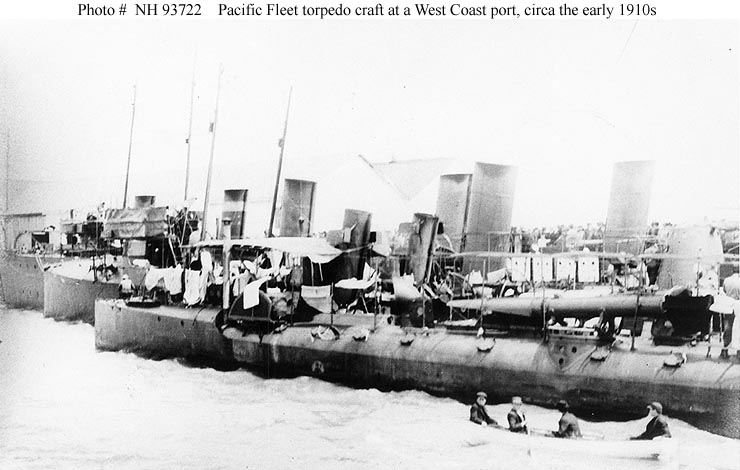 |
65k | Photo #: NH 93722. U.S. Pacific Fleet Torpedo Craft at a West Coast Port, circa the early 1910s. Ships present are (from front): USS Davis (Torpedo Boat # 12) and USS Fox (Torpedo Boat # 13) ... either could be in the foreground, with her sister immediately behind; USS Farragut (Torpedo Boat # 11); and either Paul Jones (Destroyer # 10), Perry (Destroyer # 11) or Preble (Destroyer # 12). Courtesy of Jack Howland, 1982. U.S. Naval Historical Center Photograph. | Bill Gonyo | |

| 214k | Photo MINSY 223-12-1911. USS Cleveland (C 19) is to the left of the dry dock and in dry dock are USS Preble (DD 12) (left) USS Farragut (TB 11) (right), next is USS Hopkins (DD 6) and USS Perry (DD 11) and the Tug Unadilla (YT 4) in the rear of the dock in the middle position at Mare Island on December 14, 1911. | Darryl Baker | |

| 229k | Photo MINSY 224-12-1911. USS Hopkins (DD 6) and USS Perry (DD 11) followed by USS Preble (DD 12) and USS Farragut (TB 11) are seen in dry dock #2 at Mare Island on December 14, 1911. | Darryl Baker | |
LCDR Reginald Fairfax Nicholson    May 10 1899 - ?

ENS Henry Rupert Keller    ? 1911 - ?
| Back To The Main Photo Index | To The Destroyer Index Page |
This page was created by Fred Willishaw (ex ARG-4, AS-11 & DD-692) and is maintained by David L. Wright
|