Please report any broken links or trouble you might come across to the Webmaster. Please take a moment to let us know so that we can correct any problems and make your visit as enjoyable and as informative as possible.


NavSource Online: Amphibious Photo Archive

LST-280


USS LST-280 transferred to the Royal Navy in October 1944 for the duration of World War II
Awards, Citations and Campaign Ribbons

Precedence of awards is from left to right
American Campaign Medal - Europe-Africa-Middle East Campaign Medal (1) - World War II Victory Medal


LST-1 Class Tank Landing Ship:
  • Laid down, 16 July 1943, at American Bridge Co., Ambridge, PA.
  • Launched, 26 September 1943
  • Commissioned USS LST-280, 2 November 1943
  • During World War II LST-280 was assigned to the European Theater and participated in the:
  • Transferred to the United Kingdom, 26 October 1944
  • Royal Navy History
  • Commissioned into the Royal Navy as HM LST-280, 26 October 1944
    Under repair in Thames from 8 July 1944 to 18 January 1945
    Loaded LCT-2124 aboard for Far East service
    Visited Gibraltar, Malta, Port Said, Port Tewfik, Massawa, Aden, Bombay, Cochin, Trincomalee, Vizagapatam, Madras, Malaya, Rangoon, Thailand and Singapore
    Paid off and returned to US Navy custody at Subic Bay, Philippines, 13 April 1946
  • Returned to United States Navy custody, 11 April 1946
  • Decommissioned, 13 April 1946
  • Struck from the Naval Register, 5 June 1946
  • Final Disposition, sold, 5 December 1947, to Bosey, Philippines, fate unknown
  • LST-280 earned one battle star for World War II service
    Specifications: (as reported by Office of Naval Intelligence-1945)
    Displacement 1,625 t.(lt), 4,080 t.(fl) (sea-going draft w/1675 ton load)
    Length 328' o.a.
    Beam 50'
    Draft
    (light) - 2' 4" fwd, 7' 6" aft
    (sea-going) 8' 3" fwd, 14' 1" aft
    (landing) 3' 11" fwd, 9' 10" aft (landing w/500 ton load)
    Speed 12 kts. (maximum)
    Endurance 24,000 miles @ 9kts. while displacing 3960 tons
    Complement
    7 officers, 104 enlisted
    Troop Accommodations
    16 officers, 147 enlisted
    Boats 2 LCVP
    Cargo Capacity (varied with mission - payloads between 1600 and 1900 tons)
    Typical loads
    One Landing Craft Tank (LCT), tanks, wheeled and tracked vehicles, artillery, construction equipment and military supplies. A ramp or elevator forward allowed vehicles access to tank deck from main deck
    Additional capacity included sectional pontoons carried on each side of vessel amidships, to either build Rhino Barges or use as causeways. Married to the bow ramp, the causeways would enabled payloads to be delivered ashore from deeper water or where a beachhead would not allow the vessel to be grounded forward after ballasting
    Armament (varied with availability when each vessel was outfitted. Retro-fitting was accomplished throughout WWII. The ultimate armament design for United States vessels was
    2 - Twin 40MM gun mounts w/Mk. 51 directors
    4 - Single 40MM gun mounts
    12 single 20MM gun mounts
    Propulsion two General Motors 12-567, 900hp diesel engines, two shafts, twin rudders

    Click On Image
    For Full Size Image
    Size Image Description Source
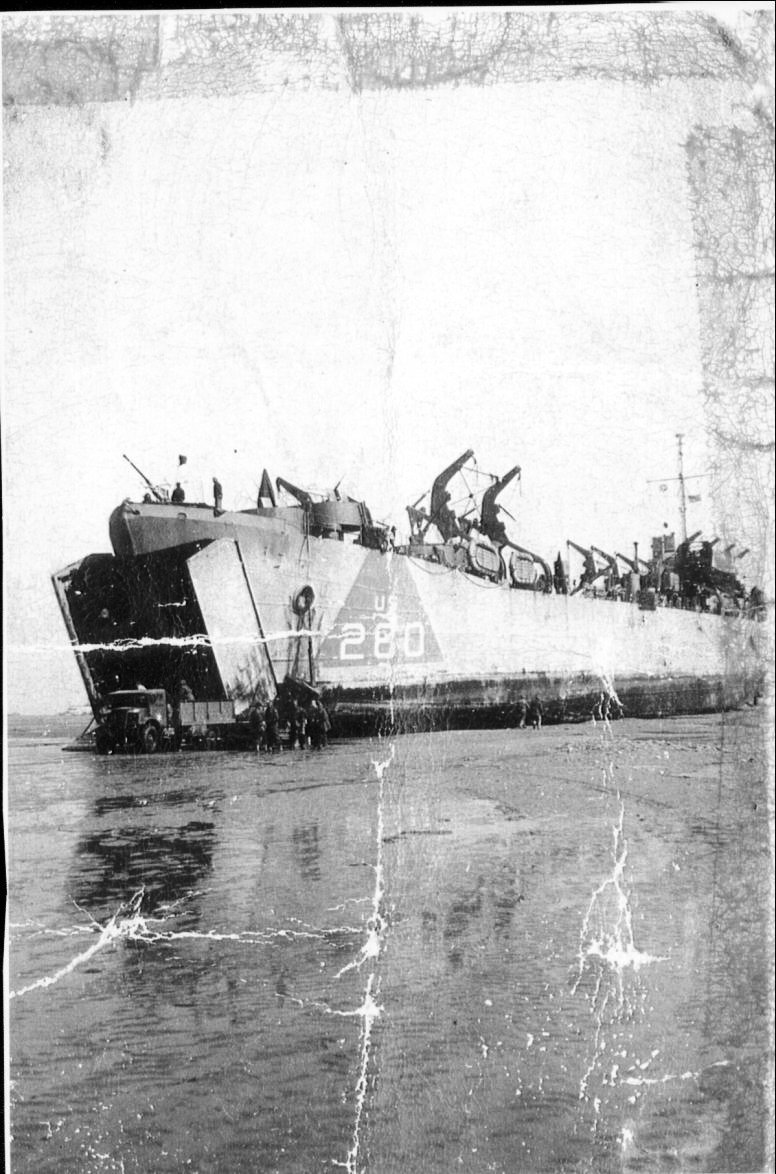
    LST-280 177k LST-280 beached at Normandy while unloading trucks, date unknown. Alex L. McGinnis MAC, USN Ret. for his father Roland T. McGinnis USS LST-280 bow gunner wounded on a return trip to England, when the ship was torpedoed, and for his uncle SSGT Alexander McGinnis, killed in action in Europe 45 days after D-Day

    View the LST-280
    DANFS history entry located at the US Naval Historical Center web site
    Crew Contact And Reunion Information
    U.S. Navy Memorial Foundation
    Fleet Reserve Association

    Additional Resources and Web Sites of Interest
    LST Home Port
    State LST Chapters
    United States LST Association
    Back To The Navsource Photo Archives Main Page Back To The Amphibious Ship Type Index Back To The Tank Landing Ship (LST) Photo Index
    Comments, Suggestions, E-mail Webmaster.
    This page is created by David W. Almond and maintained by Gary P. Priolo
    © 2005 Gary P. Priolo © 1996 - 2008 NavSource Naval History. All Rights Reserved.
    Last Updated 27 October 2006