Please report any broken links or trouble you might come across to the Webmaster. Please take a moment to let us know so that we can correct any problems and make your visit as enjoyable and as informative as possible.


NavSource Online: Amphibious Photo Archive

HM LST-415


LST-415 was transferred to the United Kingdom for the duration of World War II
LST-1 Class Tank Landing Ship
  • Laid down, 29 October 1942, at Bethlehem Fairfield Co., Baltimore, MD.
  • Launched, 21 November 1942, transferred to the United Kingdom under the Lend-Lease Act
  • Royal Navy History
  • Commissioned into the Royal Navy as HM LST-415, 19 January 1943
  • HM LST-415 participated in the following campaigns:
    Salerno landings
    Landed elements of the 89th Field Artillery Battalion of the US 45th Infantry Division
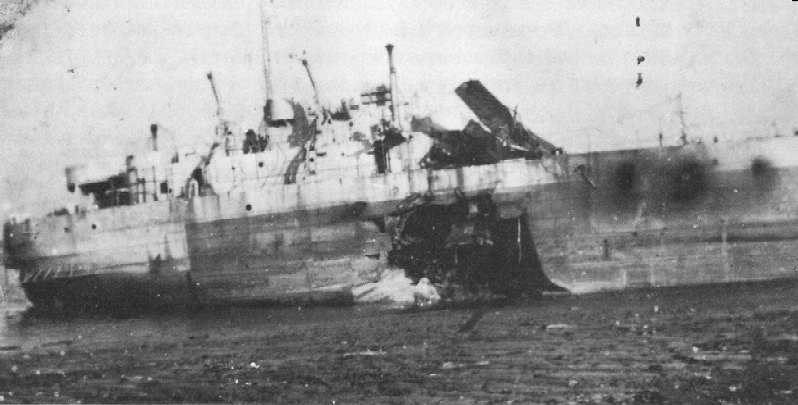
  • HM LST-415 was torpedoed and beached off Thurrock, England, 16 January 1945
  • Returned to US Naval custody, date unknown
  • Struck from the Naval Register, 2 June 1945
  • Final Disposition, sold for scrapping, January 1948, to a British scrapper
    Specifications: (as reported by Office of Naval Intelligence-1945)
    Displacement 1,625 t.(lt), 4,080 t.(fl) (sea-going draft w/1675 ton load)
    Length 328' o.a.
    Beam 50'
    Draft
    (light) - 2' 4" fwd, 7' 6" aft
    (sea-going) 8' 3" fwd, 14' 1" aft
    (landing) 3' 11" fwd, 9' 10" aft (landing w/500 ton load)
    Speed 12 kts. (maximum)
    Endurance 24,000 miles @ 9kts. while displacing 3960 tons
    Complement
    7 officers, 104 enlisted
    Troop Accommodations
    16 officers, 147 enlisted
    Boats 6 LCVP
    Cargo Capacity (varied with mission - payloads between 1600 and 1900 tons)
    Typical loads
    One Landing Craft Tank (LCT), tanks, wheeled and tracked vehicles, artillery, construction equipment and military supplies. A ramp or elevator forward allowed vehicles access to tank deck from main deck
    Additional capacity included sectional pontoons carried on each side of vessel amidships, to either build Rhino Barges or use as causeways. Married to the bow ramp, the causeways would enabled payloads to be delivered ashore from deeper water or where a beachhead would not allow the vessel to be grounded forward after ballasting
    Armament
    1 - 12 Pounder anti-aircraft multi-barrel mount
    6 - 20MM mounts
    4 - Fast Aerial Mine (FAM) mounts
    Propulsion two General Motors 12-567, 900hp diesel engines, two shafts, twin rudders

    Click On Image
    For Full Size Image
    Size Image Description Source
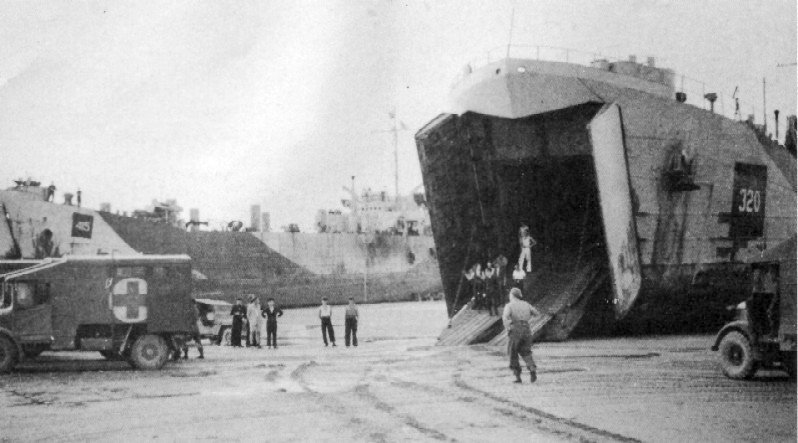
    LST-320 68k HM LST-415 and HM LST-320 on the beach at Normandy ready to return to England carrying wounded Allied soldiers, June 1944. Robert Hurst
    LST-415 66k HM LST-415 on the beach at in the River Thames at Grays, Essex, after being torpedoed by a German E-boat at 0300 hrs, 16 January, 1945. Robert Hurst

    View the LST-415
    DANFS history entry located at the US Naval History and Heritage Command
    Crew Contact And Reunion Information
    U.S. Navy Memorial Foundation - Navy Log
    Fleet Reserve Association

    Additional Resources and Web Sites of Interest
    The USS LST Ship Memorial
    LST Home Port
    State LST Chapters
    United States LST Association
    Back To The Navsource Photo Archives Main Page Back To The Amphibious Ship Type Index Back To The Tank Landing Ship (LST) Photo Index
    Comments, Suggestions, E-mail Webmaster.
    This page is created by David W. Almond and maintained by Gary P. Priolo

    All pages copyright NavSource Naval History
    Last Updated 12 February 2010