Click On Image
For Full Size Image |
Size |
Image Description |
Contributed
by and/or Copyright |
NS03xxx01 |
105k |
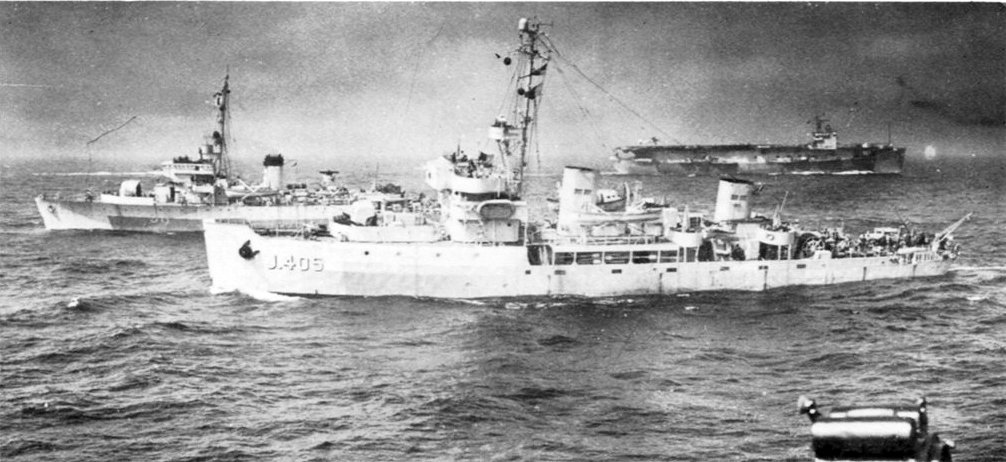
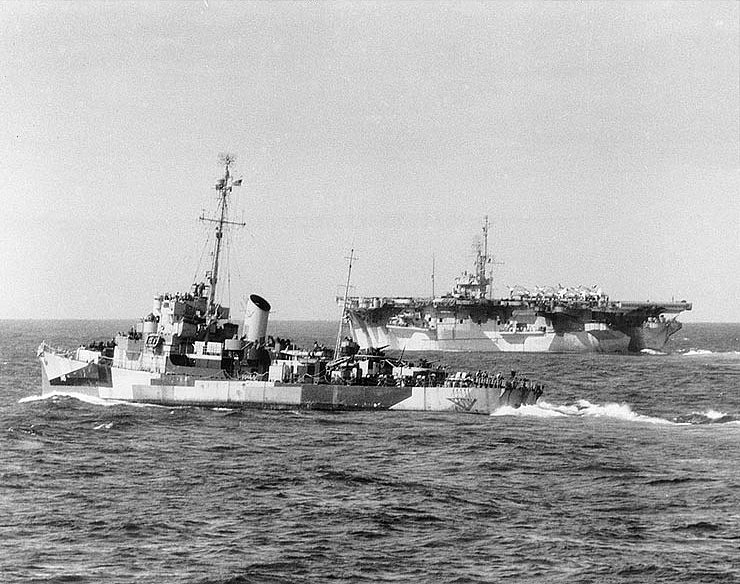
An unidentified U.S.-built escort carrier, background, in Royal Navy service. In the
foreground is the U.S.-built Catherine-class fleet minesweeper HMS Foam
(J405, ex-BAM 27) along with an Algerine-class fleet minesweeper, apparently HMS Bramble.
Imperial War Museum photo, from "Allied Escort Ships of World War II," by Peter Elliott.
Tony Drury pointed out: "Assuming that the ID of HMS Bramble is correct (I can't read her
number) this picture is in UK waters as Bramble only operated in UK waters and the western approaches.
Bramble didn't begin operating until July 1945 so this gives us a starting point. The CVE Puncher
made her maiden voyage (San Diego to New York) in company with HMS Foam but I can't trace the
sweeper's whereabouts after she reached the UK in the summer of 1944."
Later, Tony Drury found additional information and wrote [the second minesweeper appears to be HMS
Wave, rather than HMS Bramble]:
"Operation Shred and Groundsheet (21st to 23 February 1945)"
"The object of Shred was for the Tenth Minesweeping Flotilla to sweep a channel through QZX 1452,
which was achieved. No mines were cut."
"Groundsheet was a minelaying operation by aircraft in Salhusstrommen and provide fighter cover
for the Tenth Minesweeping Flotilla. 1 Do 24 was destroyed at its moorings and buildings on shore
shot up. 2 Barracudas were lost."
"Forces taking part were: Dido (Vice Admiral Commanding, Tenth Cruiser Squadron), Puncher,
Premier, Myngs (Captain (D) 23rd Destroyer Flotilla), Cavalier,
Scorpion, Courier (Senior Officer, Tenth Minesweeping Flotilla), Hare, Jewel,
Wave, Serene, Golden Fleece, R.M.L. 551, R.M.L. 545."
(Quoted from Naval-History.net.)
"This is the only instance of the ships operating together, unfortunately the image is not good
enough to distinguish Puncher from Premier."
|
Robert Hurst |
NS03xxx02
NS0311424 |
95k |
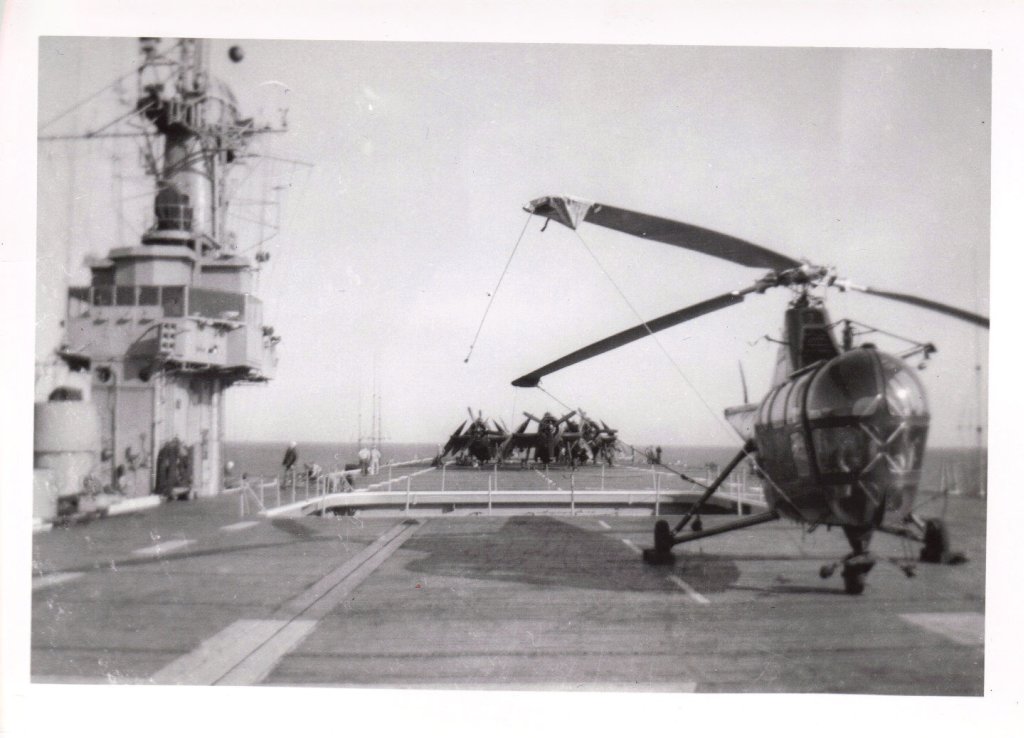
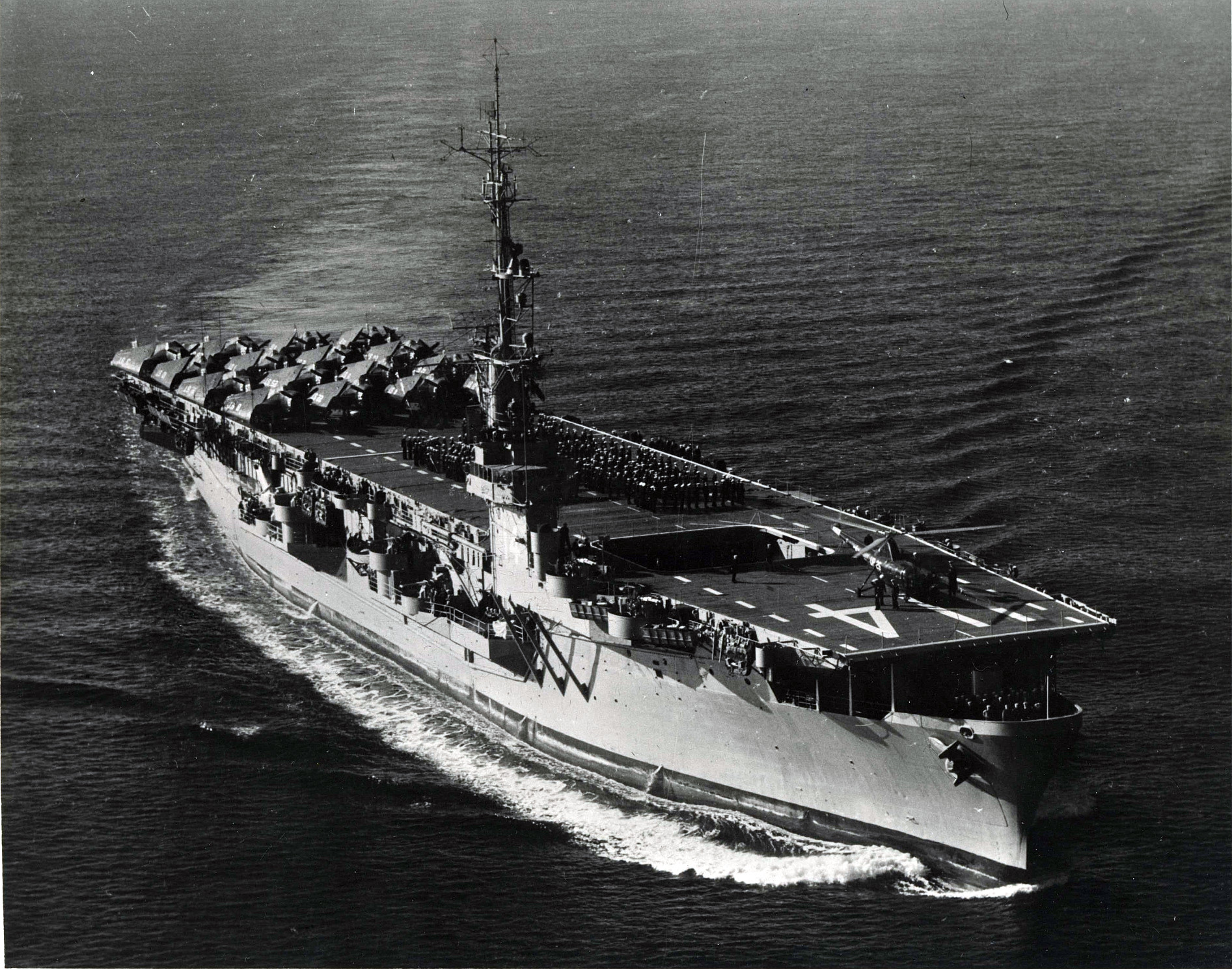
An unknown CVE with a Sikorsky HO3S-1 helicopter on deck. My guess is USS Badoeng
Strait (CVE-116), but there is nothing in the photo to identify the squadrons or the ship.
Can you identify the ship, date or location? (Larger image available on request.)
David Buell has identified this ship as USS Rendova (CVE-114)
and writes:
- Using the larger photo you sent, I listed certain salient features of the island structure and
equipment.
These included the radars and their positions, configurations of bulwarks, and masts.
- I listed and eliminated any CVEs which did not carry the features seen in this photo. Primarily,
this first item is SPS-6 radar, which this photo shows. This eliminates CVEs 105,
109, 111, 113 and 117.
Added to this group are CVEs 121 and 123, which were completed
but never operational. SPS-6 became operational about the time of the Korean War, which helps date
this photo. The above noted CVEs went out of commission right after World War II and only carried
SK-2 radar, never SPS-6.
- Another feature seen in various locations on all he CVE 105 class are the DBM radar domes which
were typically mounted two on a bracket on the mainmast either low and just above the bridge itself
or higher up near the SP radar. Using photos available on NavSource as well as my personal collection,
I listed all 105-class CVEs and the positions of their DBM domes. As it turned out, a few had DBM
mounted in a third configuration. More about this later. The book by Stephan Terzibaschitsch, "Escort
Carriers and Aviation Support Ships of the US Navy" was a valuable resource as it contains dozens
of CVE 105 class photos.
- Another identifying feature is a small bulwark on the roof of the island which is probably the
secondary conn. All of the photos I have seen of the Commencement Bay-class as commissioned
have either an open railing or a canvas "dodger" over the railing at this position. However, most
if not all of the class active postwar received a steel bulwark around this position. There were three
types seen in photos, but the type seen in the Mystery Photo is of interest here. Only four CVEs had
this type bulwark, so used this as my second eliminator (after the SPS-6) for identification. These
CVEs are Rendova, Bairoko, Badoeng
Strait, and Point Cruz. This bulwark varies from the other two
variations in that is slightly angular, has a wind baffle at the top, and smooth on front.
- DBM locations. The Mystery Photo has no low-mounted DBM bracket over the bridge, so that eliminates
Bairoko and Badoeng Strait who had DBM twin mounted on the bracket low over the bridge.
They would have shown in the Mystery Photo were they present. This leaves Rendova and Point
Cruz. Point Cruz had her SPS-6 mounted forward on the mast, not aft as in the Mystery photo,
and did not have the DBM domes bracketed singally as seen in the mystery photo towards the top of the
frame, although hers were not on a double bracket either. Rendova is the only one with this
configuration. The last photo of Rendova on the NavSource page
that was submitted by Darryl Baker shows this to good effect. In the Mystery Photo, the DBM is dark
but visable.
- Trump card: In the Mystery Photo, the starboard catapult runs toward the photographer and changes
color as it runs into the ship's number painted on the flight deck. At the very bottom edge of the
photo, one can see a lighter section with an angled tip to the right. This is the bottom of a "4"
painted on the flight deck. Refer to the photo on the NavSource Rendova
page submitted by Stanley Svec of a crew formation on the flight deck and you can see how the number
"4" and the flight deck markings also match up those to those in the Mystery Photo.
All other USN numbers have curves (except "1" & "7" but CVEs 111/117 were not active at the time
of this photo).
Also seen in the Mystery Photo is the stub of the number "1" on the flight deck further to the right
of frame.
The position of the catapult in relation to the deck edge determined the locations of the painted on
numbers.
Since no other CVE-105 class ship carried a number "4" on its flight deck, I am 100% certain that this
is USS Rendova, CVE 114.
Bob Crawford also comments: "Am I the only one noticing the inverted '4' in the bottom left
and the bottom of a '1' just forward of the Helo? If you look at photo NS0311423
on USS Rendova page, it seems to fit the format."
Yu Chu adds adds: "My opinion is this was taken in 1953. Reasons [compare to photo NS0311435]:
- In both pictures her island crane is not visible
- Both pictures had the helicopter on the forward carrier deck though not same position
- All visible main mast components are present in the 1953 picture"
|
Robert M. Cieri |
NS03xxx03 |
169k |
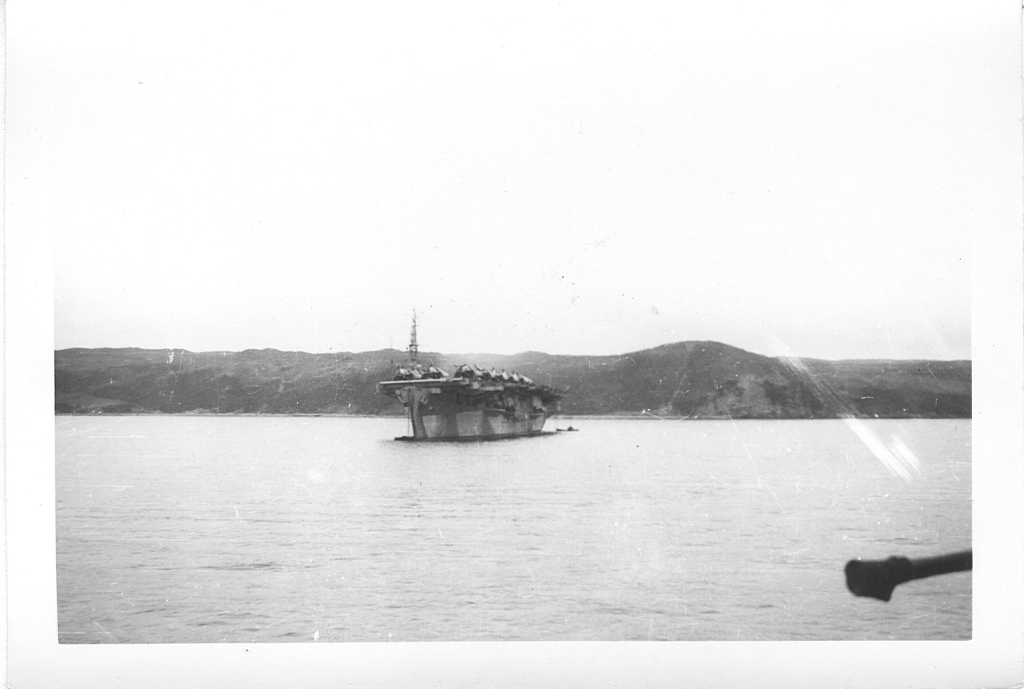
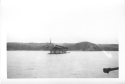
"Here is a CVE, Bogue-class from the look of it, and the Measure 32 camouflage
[...]"
"At any rate, the number on the bow is not too legible, but looks like a double number. With a
full air group of TBM Avengers on deck, my guess would be USS Card
(CVE-11), but I am not sure if she wore this exact design of Measure 32, and the number is too blurred
to make out well."
Camo scheme appears to be a variant of Design 4A, with a dark patch on the bow. Other photos in
the same collection are related to North Africa and South America operations, circa 1943–44.
Robert Tilley notes:
- The CVE in this photo appears to have a slight list to starboard.
- In the center of this photo and above the flight deck there appears to be light colored haze rising,
reminiscent of white smoke from a recently extinguished fire.
- There are 12 CVE's
listed with various degrees of repairable damage that made port for temporary repairs.
- The dark object in the lower right of this photo looks like the business end of a single 40mm barrel.
(Slightly larger copy available on request.)
|
David Buell |
NS03xxx04 |
100k |
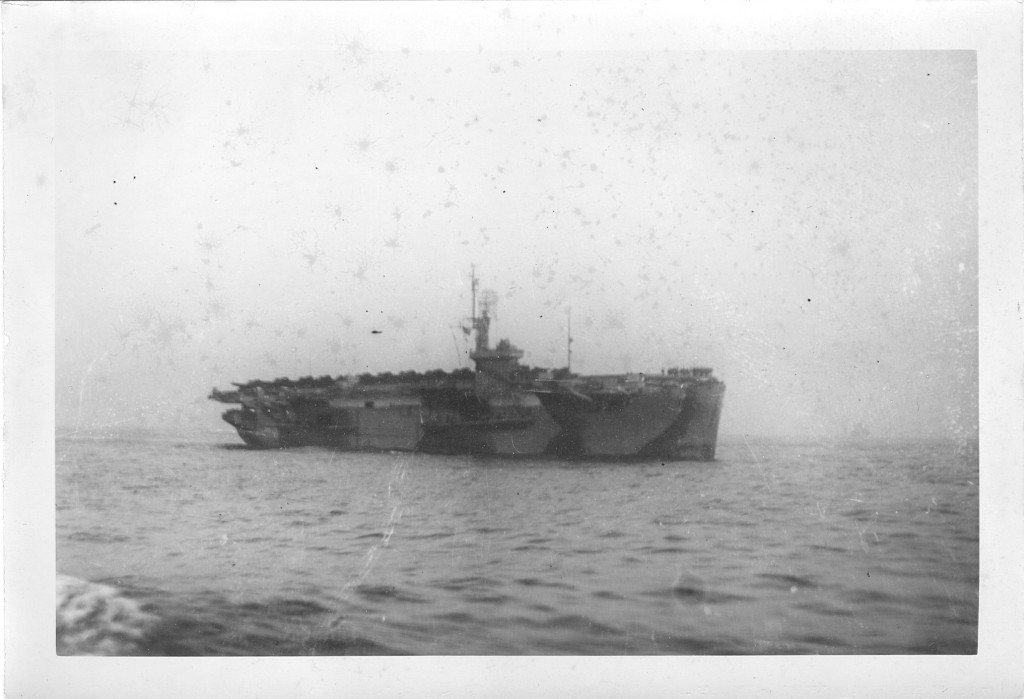
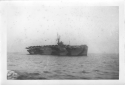
"From my reckoning it is either Bogue, Card
or Core, based on dates and camouflage. That is about as far as I can
get. I believe they all carried SK radar at some time or another. Except for Block
Island and Croatan which I think only wore Measure 22, the rest
of the Bogues were Pacific-based only. This CVE shows the Atlantic direction-finder mast forward,
and I do not believe this camoflage pattern was on any Pacific CVE that I have seen photos of. Finally,
that leaves Prince William as an unlikely candidate, as she entered the
Atlantic late in the game, but she did do one ferry run of aircraft to Casablanca in August 1944.
Have not seen photos of her in pattern camoflage, so the jury is still out on her."
"This photo also shows the countershading paint under the starboard flight deck overhang."
Yu Chu comments:
"I have no exact answer due to the dazzle kept on changing.
It's either Core or Card.
USS Core has similar measure but the only difference is the stripe on her island.
USS Card also wears the same measure but less photograph of her dazzle."
(Larger copy available on request.)
|
David Buell |
NS0614502 |
119k |
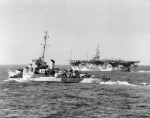
USS Huse (DE-145) operating
with an escort carrier (CVE) in the Atlantic area, 12 December 1944. Photographed by PhoM3. Joseph
W. Lehan. Huse's port side is painted in camouflage Measure 33, Design 3d(gx).
Official U.S. Navy photograph, now in the collections of the National Archives (# 80-G-350736).
The CVE is possibly USS Croatan (CVE-25). Can you conclusively identify
her?
Lucas Aparicio comments:
"I can confirm that the carrier in the photo is the Croatan. The Huse and the Croatan
were both a part of the same anti-sub group. Both of them were in port from October 1944 to February
1945. Though they were in different ports, Huse in Brooklyn and Croatan in Norfolk,
it is reasonable to assume that in that time period they trained and ran exercises together due to
the fact they were part of the same anti-sub group and their main training area was the Caribbean and
the Atlantic. Since the Croatan deployed in February 1945 and the Huse deployed one
month later in March 1945, them training and running exercises in December sounds about right. So
that photo is the Croatan and Huse training together in the Atlantic right before they
deployed."
|
Robert Hurst |
![carrierinfo [at] navsource [dot] com](../02/carrierinfo.gif)