0601001
|
73k |
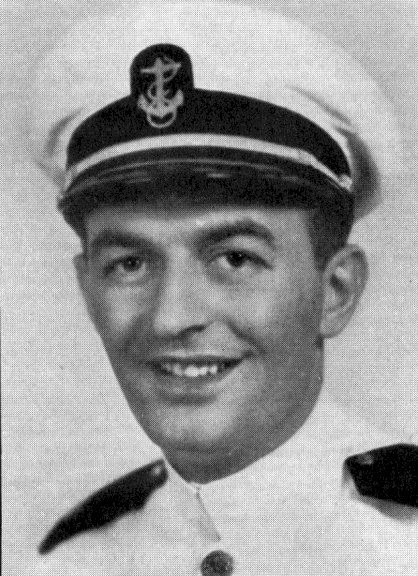
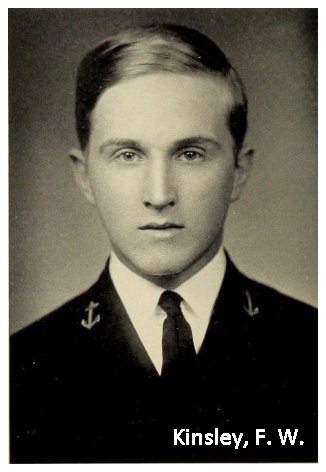
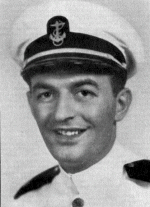
Gus George Bebas was born on 24 February 1914 in Chicago, Ill. He received his commission as an ensign in the U.S. Naval Reserve on 26 May 1938 while attending
the Northwestern University School of Engineering, earning a B.S. degree in commerce in 1939. Bebas served in the Naval Reserve Officer Training Corps at that institution, and trained on board
USS Wichita (CA 45) between 16 and 30 June 1939. His commission as an ensign terminated on 22 January 1940 and he enlisted the following day as a seaman second class. He completed
one stint of elimination flight training at Naval Reserve Aviation Base Glenview between 14 February and 14 March 1940, and a second between 15 December 1940 and 15 January 1941. His enlistment
terminated 19 February when he became an aviation cadet, USNR, and reported for training at Naval Air Station), Pensacola, the following day. Transferred to NAS Miami for further training on
04 August, he was appointed naval aviator No. 8779, on 05 September. Released from active duty involving training on 25 September, he received promotion to ensign, A-V(N), USNR, the following
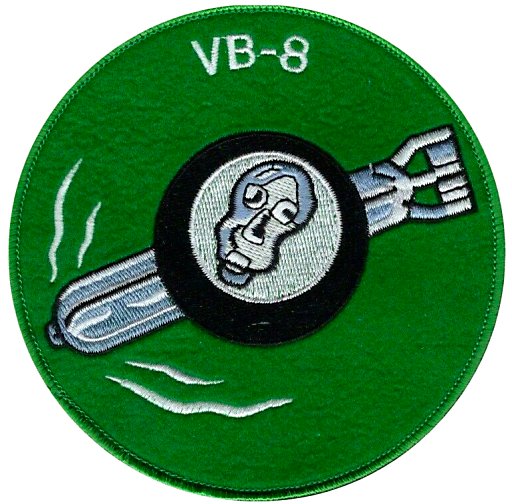
day. Assigned to the Advanced Carrier Training Group, Atlantic Fleet, on 26 September, Bebas reported to the Curtiss SBC-3-equipped Bombing Squadron (VB) 8, part of the Hornet
(CV 8) Air Group, two days before Christmas of 1941.
When Hornet sailed for the Pacific in March 1942, his squadron was re-equipping with the Douglas SBD-3 Dauntless. During the first day of the Battle of Midway, 04 June 1942, Bebas
flew with VB-8 in the first strike from Task Force 16, but his squadron did not locate the enemy, flying to Midway and thence, after refueling, back to the ship. The next afternoon, 5 June, he
participated in the search for the damaged Japanese carrier Hiryu. Not finding her (she had actually sunk long before), Bombing 8 pounced on the destroyer Tanikaze
instead. On the afternoon of 06 June, he took part in strikes flown against the heavy cruisers Mogamiand Mikuna and their screening destroyers, scoring a damaging near
miss on Mogami in the face of heavy antiaircraft fire. This display of courageous conduct and devotion earned him the Distinguished Flying Cross. Hornet returned to
Pearl Harbor following the Battle of Midway, and her air group, shore-based, returned to operational training. While on a routine three-plane bombing flight off Oahu on the morning of 19 July 1942,
Bebas pushed over into a dive on a target boat maneuvering off Barber’s Point, and released his practice bomb at 2,000 feet. Instead of immediately recovering, however, he entered a relatively
steep right turn. He either blacked-out or could not overcome the heavy stick forces present in the dive, and his SBD-3 (BuNo 4573) crashed into the ocean, killing Bebas and his passenger, Ens.
William M. Stevens, D-V(G), USNR.
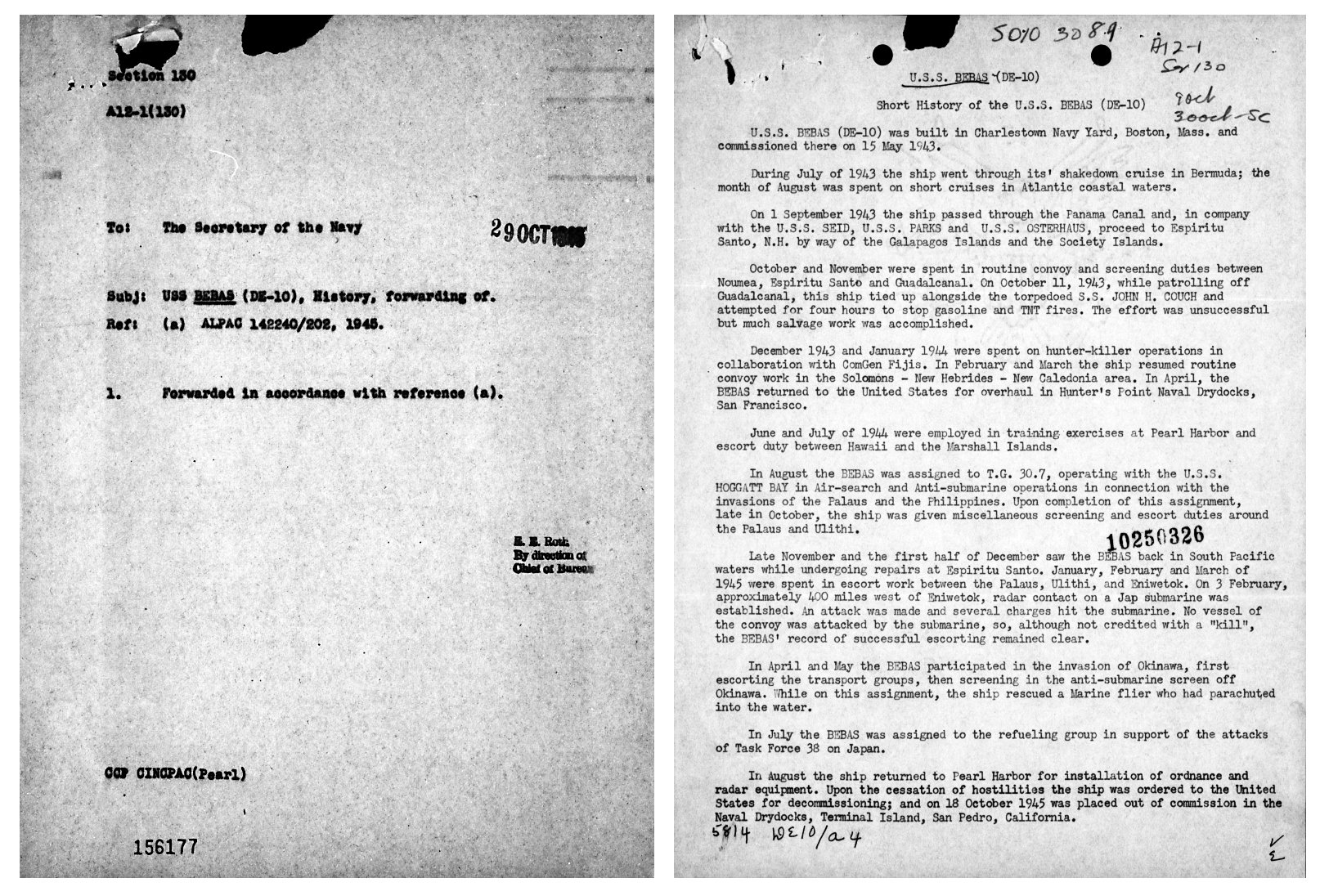
USS Bebas (DE 10) (1943-1945) was the first ship to be named in his honor.
(Photo from the November 1942 edition of the Northwestern University Alumni News thanks to the assistance of Allyson Mauck of the Northwestern University Alumni Association and Kevin B. Leonard of the Northwestern University Archives) |
Bill Gonyo
Downey, Cal.
Assoc. Researcher
Navsource |
0601005 |
90k |
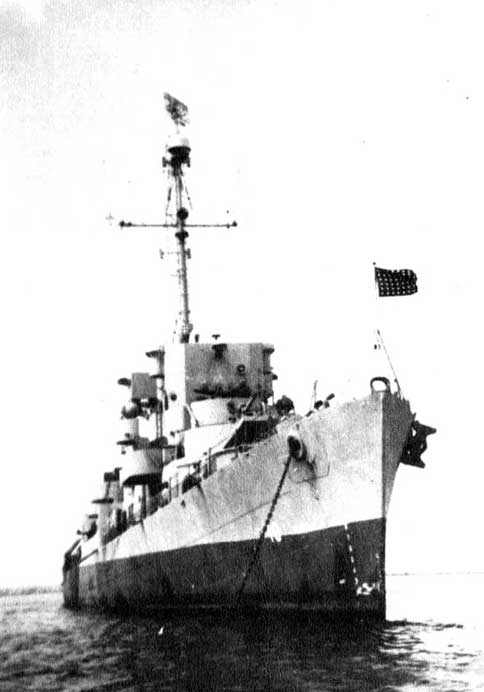
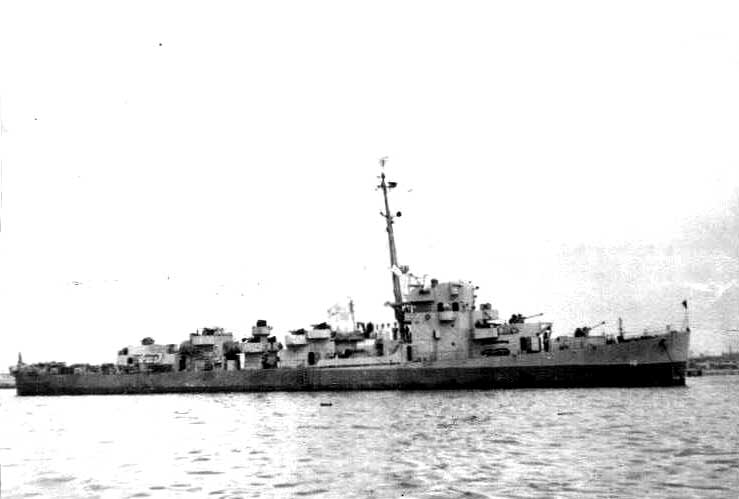
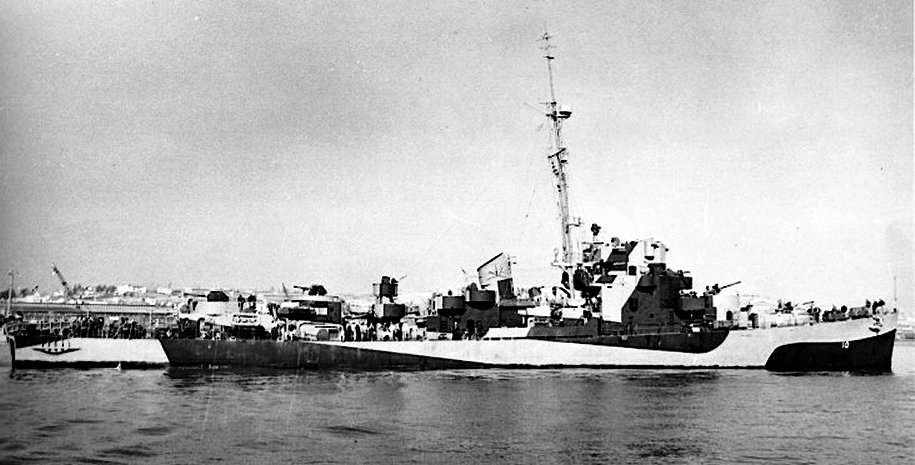
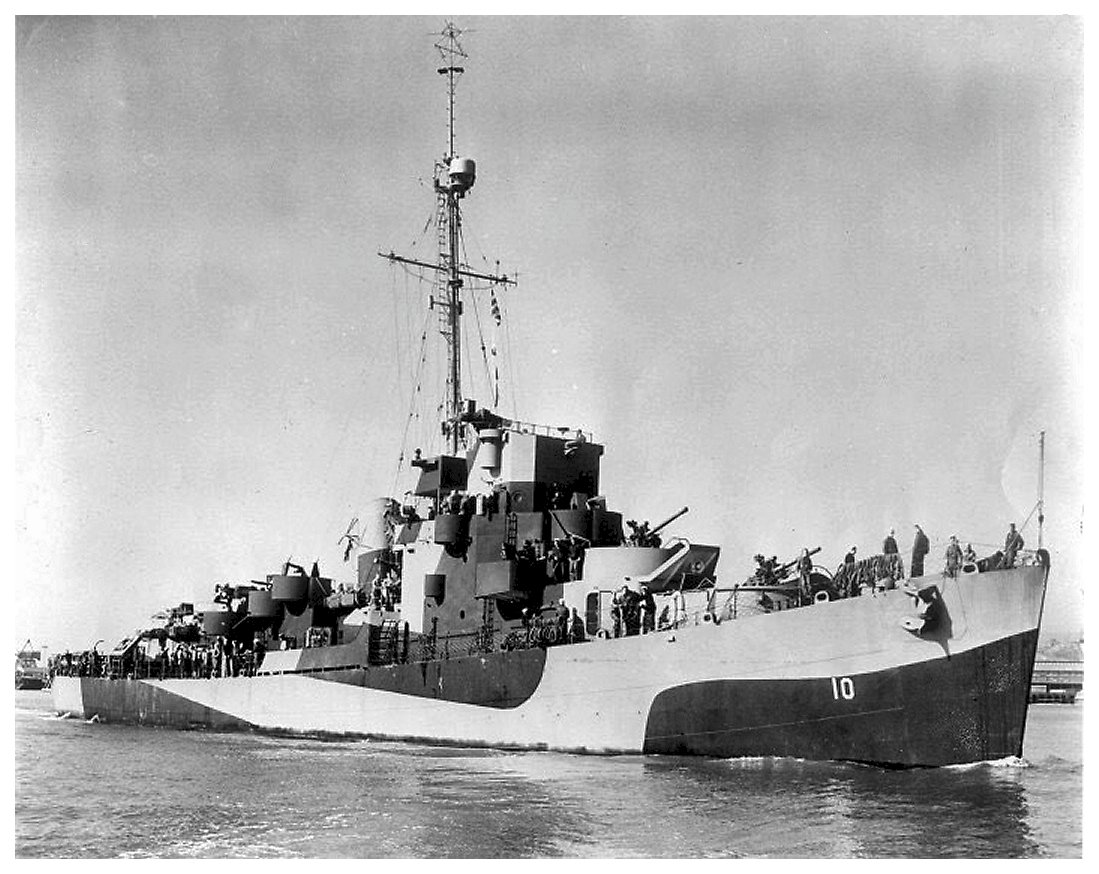
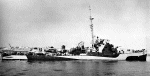
These photos were dated 24 May 1944 in San Francisco Bay, on that day Bebas was anchored in Purvis Bay, just north of Guadalcanal
in the Solomon Islands. We were unable to ascertain that Bebas was ever at Hunters Point or any of the other shipyards in the San Francisco Bay area.
Upper Photo: USS Bebas (DE 10) as seen from the starboard bow at Hunters Point in camouflage scheme MS32/22D on 24 May 1944.
(U.S. Navy, Bureau of Shipping, Catalog #BS 69837 from the United States National Archives)
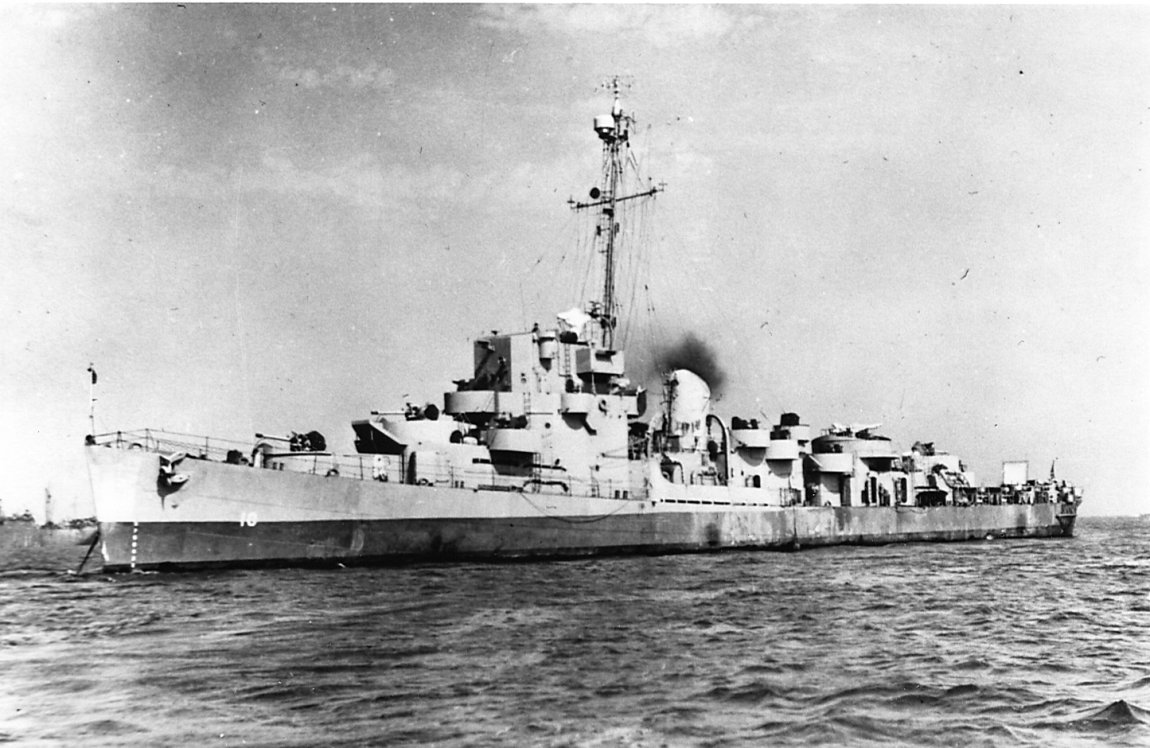
Lower Photo: USS Bebas (DE 10) off Hunters Point, San Francisco wearing camouflage measure MS31/22D. Bebas is carrying a HF/DF antenna on top of the mast
above the SR radar dome. The HF/DF was not usually deployed on Pacific Fleet destroyer escorts, since, while it was used to detect radio transmissions from enemy submarines, This was
not deemed as effective against Japanese submarines as against German U-Boats. Bebas had been in the Atlantic between May and August 1943, but was assigned to the Pacific
after completing shakedown and spending the next few weeks in coastal escort and patrol operations out of Casco Bay in Maine, Boston, New York, and Norfolk. Bebas departed
Hampton Roads on 24 August 1943 for the Pacific.
(U.S. Navy, Bureau of Shipping, Catalog #BS 69838 from the United States National Archives) |
Mike Green
Port Angeles, Wash. |