| Click On Image For Full Size Image |
Size | Image Description | Contributed By And/Or Copyright |
||||||||||||||||||||||||||||||||||||||||||||||||||||||||
|---|---|---|---|---|---|---|---|---|---|---|---|---|---|---|---|---|---|---|---|---|---|---|---|---|---|---|---|---|---|---|---|---|---|---|---|---|---|---|---|---|---|---|---|---|---|---|---|---|---|---|---|---|---|---|---|---|---|---|---|
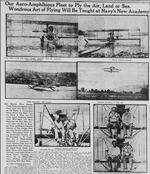 |
1.10k | Our Aero-Amphibious Fleet to Ply the Air, Land or Sea. Wondrous Art of Flying Will Be Taught at Navy's New Academy |
Image and text provided by Library of Virginia; Richmond, VA. Photo from The Times Dispatch. (Richmond, Va.) 1903-1914, 20 August 1911, Image 9, via chroniclingamerica.loc.gov.  112k |
View on the Mississippi's (BB-23) afterdeck, while she was carrying the Navy's first combat air group to Vera Cruz, Mexico, in April 1914. Planes visible include a Curtiss "AB" type flying boat (on deck at left), and a Curtiss "AH" type floatplane (atop the after 12"/45 gun turret). Note boom rigged to the battleship's superstructure, at left, for hoisting the planes on and off the ship. |
Official USN photo # 80-G-461428, now in the collections of the National Archives. |  68k |
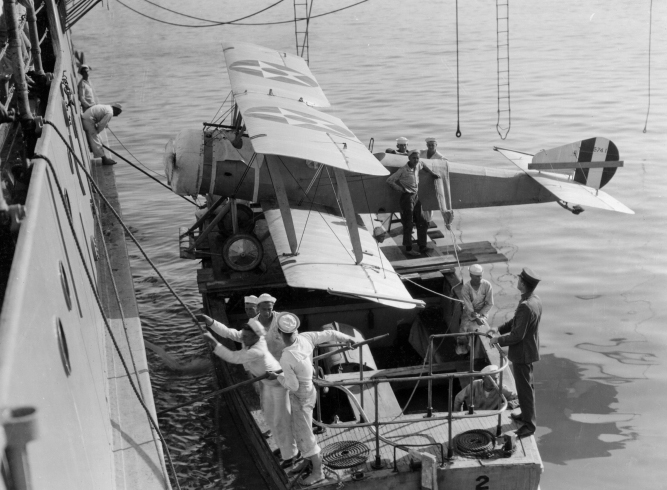
A Curtiss AB-3 lowered into water from Mississippi (BB-23), April 1914. |
Photo from the University of San Diego History Department & submitted by Bill Gonyo. | 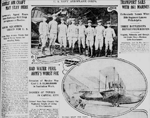 1.90k |
U. S. NAVY AEROPLANE CORPS. |
Flying Boat Aviator Points Out Need of Flying Scouts for Invading Army Image and text provided by Library of Congress, Washington, DC. | Photo from New-York Tribune. (New York [N.Y.]) 1866-1924, 24 April 1914, Image 5, via chroniclingamerica.loc.gov.  1.90k |
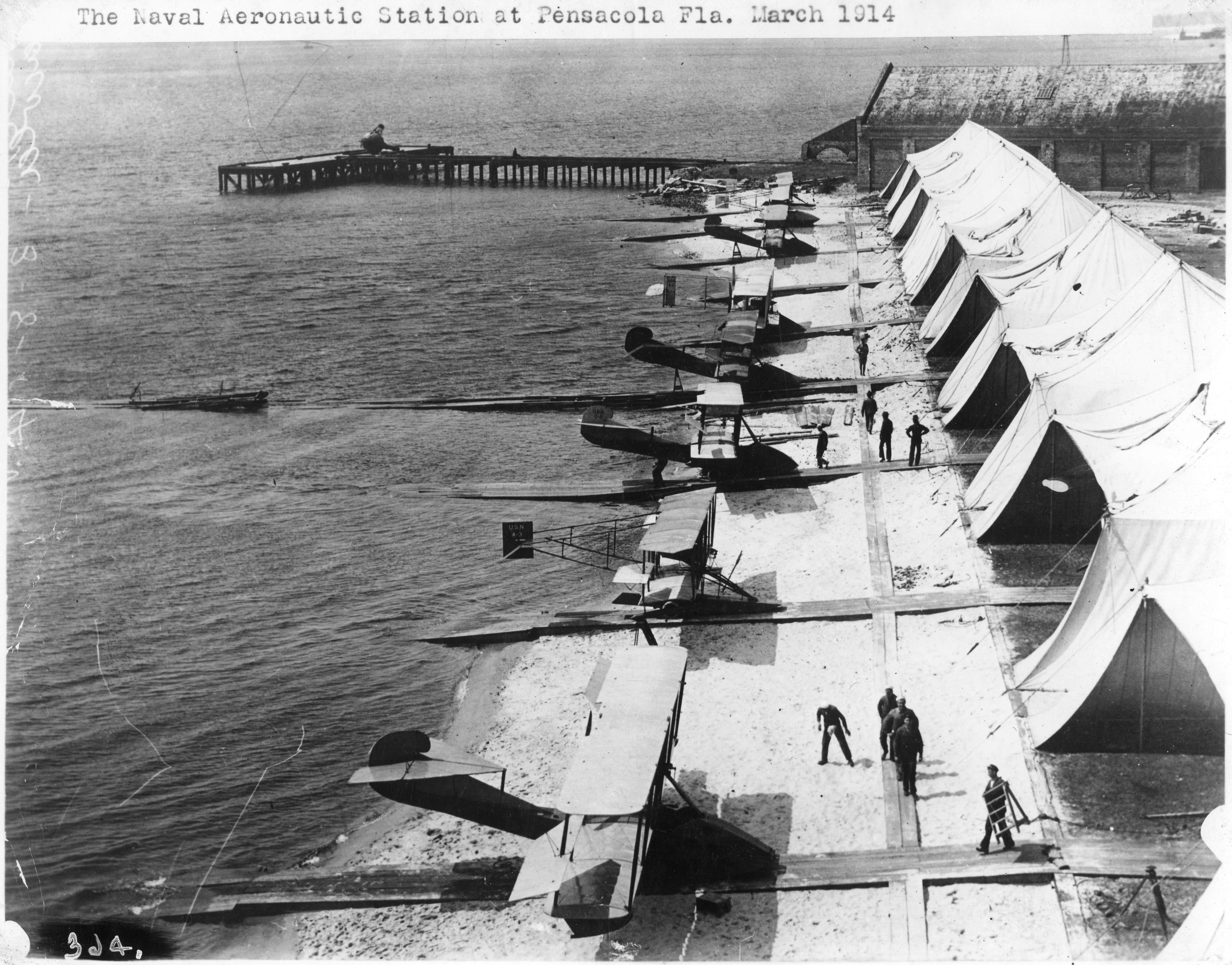
On 25 April, Lieutenant (junior grade) Patrick N.L. Bellinger climbed aboard the AB-3 flying boat and made a reconnaissance over the waters around Veracruz in search of mines that had been reported, thus having the distinction of making the first flight of an American military aircraft under combat conditions. Operating from rustic encampments ashore, the naval aircraft instituted a regular schedule of flights from both Tampico and Veracruz, though the most action came at the latter location. |
On 2 May 1914, Bellinger and Ensign W.D. Lamont flew the AH-3 hydroaeroplane in direct support of ground troops when they were called upon to perform aerial reconnaissance near Tejar, Mexico, in search of enemy forces firing at encamped U.S. Marines. Four days later, Bellinger and Lieutenant (junior grade) Richard C. Saufley returned from a mission with bullet holes in the fabric wing of their aircraft, having been taken under fire by Mexican riflemen during a scouting flight. As Bellinger later recounted in an article for National Geographic, the U.S. aircraft carried no weapons and on one of his last flights in Mexico, he decided to exact some measure of revenge on the Mexican forces and grabbed the nearest thing he could find in camp. Thus, he made a bar of soap the first air to ground ordnance dropped from a Navy aircraft. Photo & text from April 2009 edition of navalaviationmuseum.org. | AH-3 link is Photo # NH 2275 from the U.S. Naval History and Heritage Command via ibiblio.org. PDF Image and text provided by University of South Carolina; Columbia, SC. Photo from The Anderson Daily Intelligencer. (Anderson, S.C.) 1914-1917, 01 May 1914, Image 5, via chroniclingamerica.loc.gov. 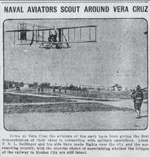 730k |
NAVAL AVIATORS SCOUT AROUND VERA CRUZ |
Down at Vera Cruz the aviators of the navy have been giving the first demonstration of their value in connection with military operations. Lieut. P. N. L. Bellinger and his aids have made flights over the city and the surrounding country, with the especial object of ascertaining whether the bridges of the rallway to Mexico City are still intact. Image and text provided by University of Nebraska-Lincoln Libraries, Lincoln, NE. | Photo courtesy of Dakota County Herald. (Dakota City, Neb.) 1891-1965, 07 May 1914, Image 3, via chroniclingamerica.loc.gov. 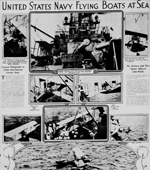 757k |
United States Navy Flying Boats at Sea |
Image and text provided by Library of Congress, Washington, DC. | Photo from New-York Tribune. (New York [N.Y.]) 1866-1924, 05 July 1914, Image 40, via chroniclingamerica.loc.gov.  2.08k | WAR AWAKENS U. NAVY TO IMPORTANCE OF AIRCRAFT | Ultimate Objective Is to Put Country Far Ahead of Any European Power in Air Scouting
Image and text provided by The New York Public Library, Astor, Lenox and Tilden Foundation. |
Photo by The Sun. (New York [N.Y.]) 1833-1916, 20 June 1915, FIFTH SECTION SPECIAL FEATURE MAGAZINE, Image 40, courtesy of chroniclingamerica.loc.gov. PDF added 06/14/13. 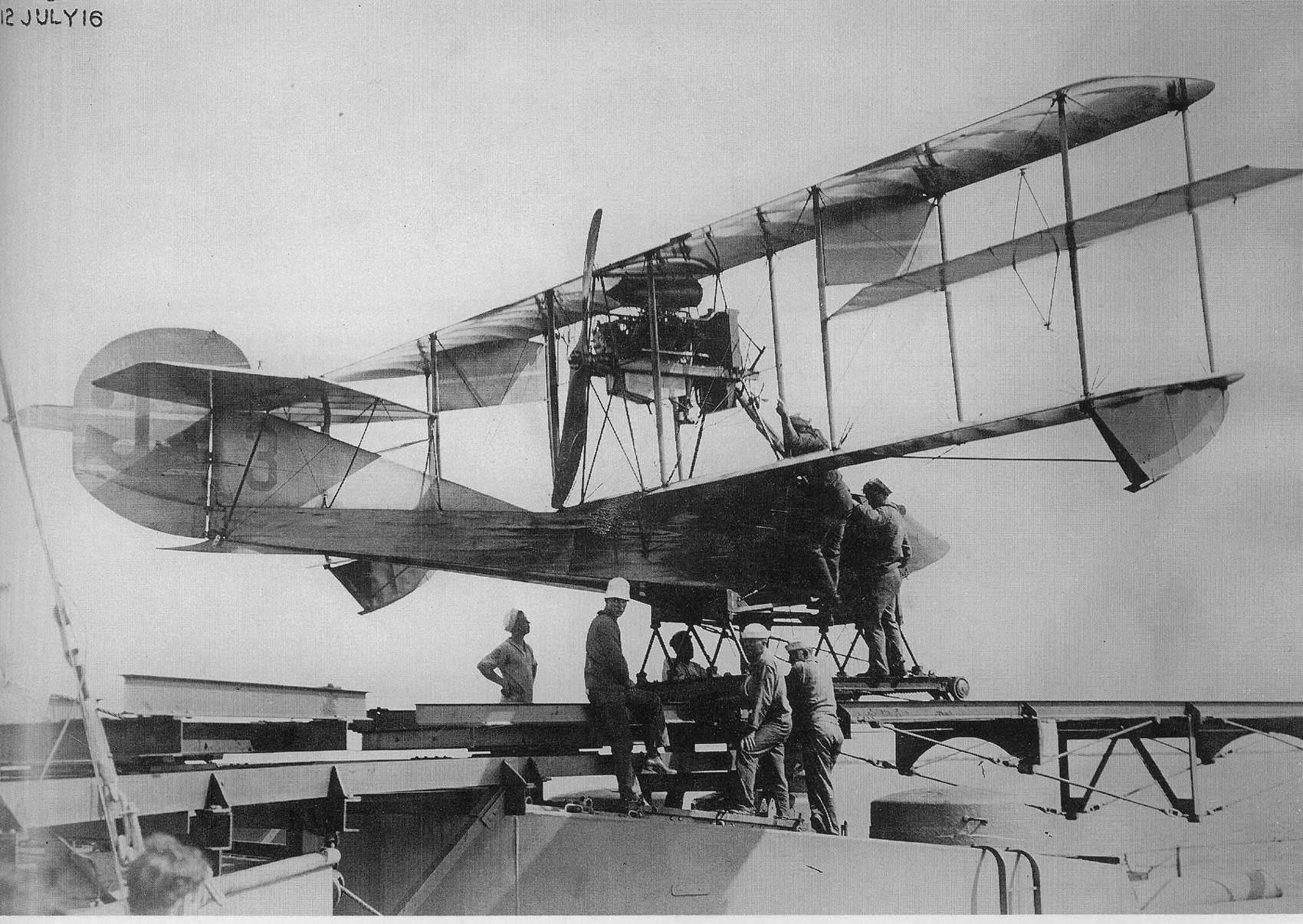 344k |
A Curtiss AB-3 on special rails leading to the catapult aboard North Carolina (ACR-12), the first ship in the Navy to be authorized to carry and operate aircraft on 12 July 1916. |
On 14 November 1910, Eugene Ely flew a Curtiss pusher from a platform built along the length of the bow of the Birmingham (CS-2) marking the start of shipboard naval aviation. The platform built of the Birmingham and the one built across the stern of Pennsylvania (ACR-4) which Ely both landed and launched his Curtiss three month later, were built over the top of the cruisers’ armament. This arrangement was fine for the experimenting but would interfere with the ships performance of its primary duties as a cruiser. Though the U.S. Navy had developed shipboard catapults and assigned ships for aviation development by 1917 all this work ceased with the U.S. entrance into World War I. Text & photos courtesy of Chris Hoehn. |  1.05k |
OUR NAVY AVIATORS HAVE DONE MUCH DESPITE HANDICAPS | Initiative in Marine Flying Early Taken by Small Group of Pioneers and Maintained Despite Odds Image and text provided by The New York Public Library, Astor, Lenox and Tilden Foundation. | Photo courtesy of The Sun. (New York, [N.Y.]) 1916-1920, 19 August 1917, Section 5 Special Feature Supplement, Image 31, via chroniclingamerica.loc.gov. 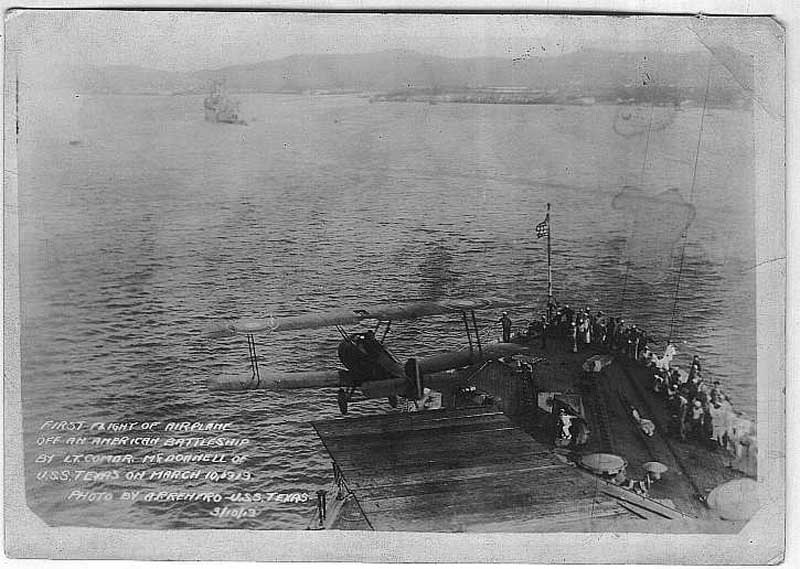 157k |
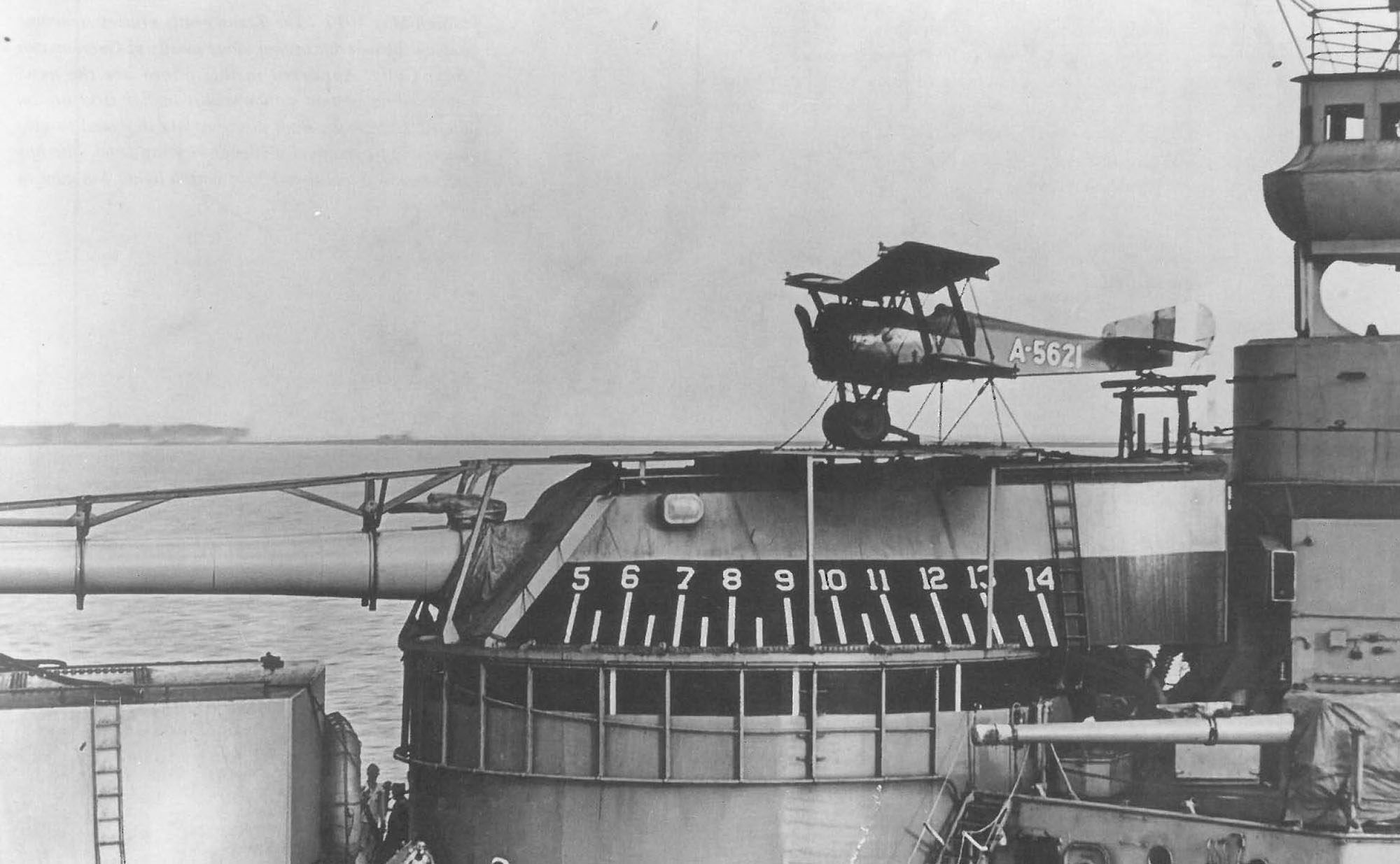
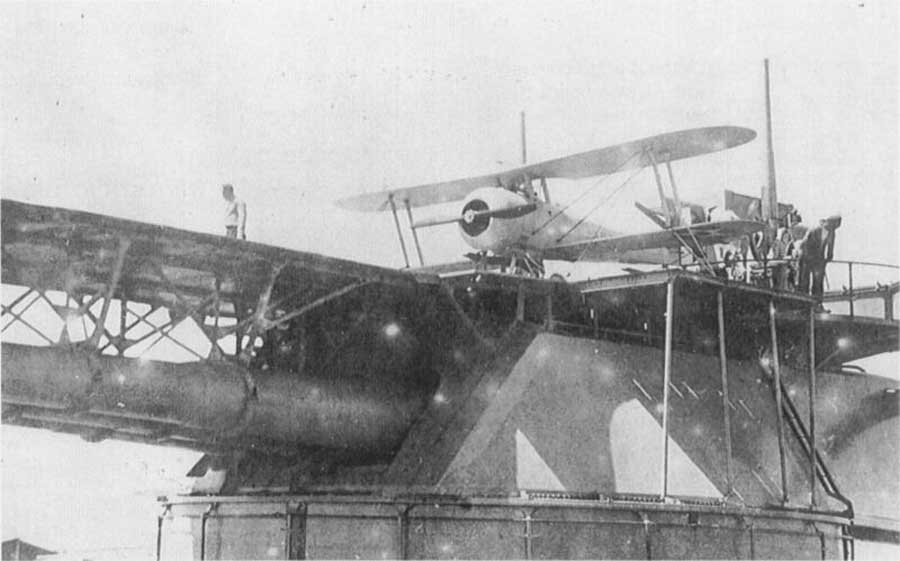
The turret fly-off platform was developed during World War I, by the Royal Navy in an effort to provide fighter protection for the fleet operating outside the range of shore based aircraft, especially against the high flying zeppelins of the German High Seas Fleet. The added weight and drag caused by the pontoons of a seaplane made them vulnerable to more manuverable and faster land based fighters and unable to reach the altitudes needed to attack zeppelins. Thus the aircraft flown from these platforms were all equipped with standard undercarriages and unless launched within flying distance of friendly territory, were good for only one flight. Otherwise, the pilot would ditch along side his parent-ship and be recovered along with his damaged aircraft. The advantage of this system was that it was contained entirely atop a single turret and constructed to allow the turret to operate with a minimum of interference. |
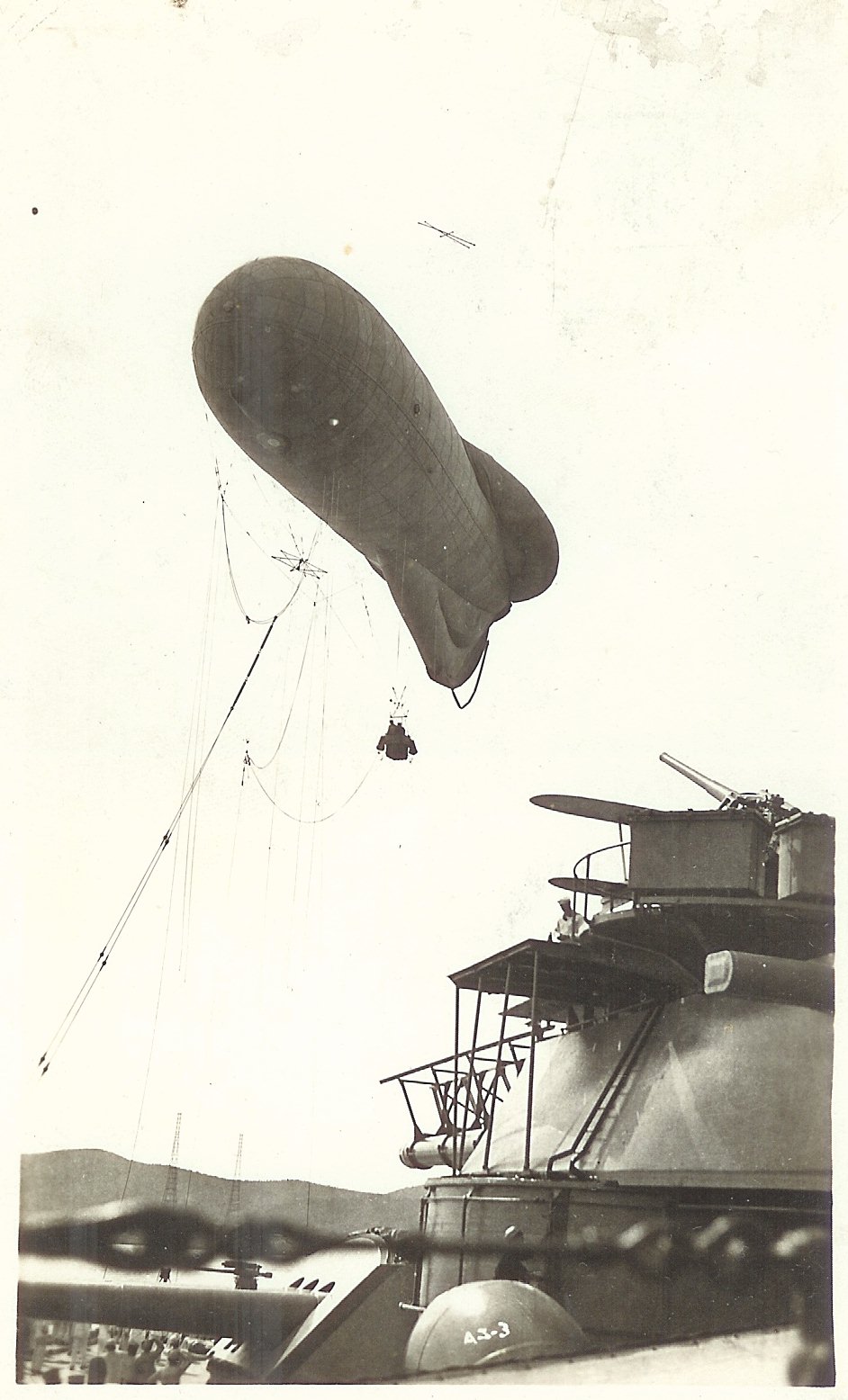
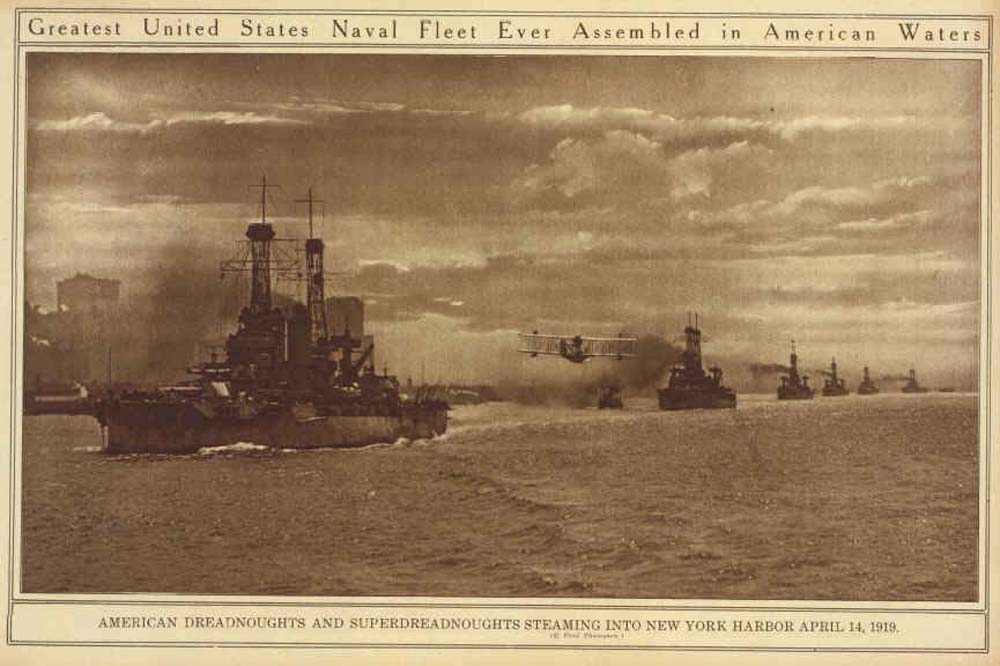
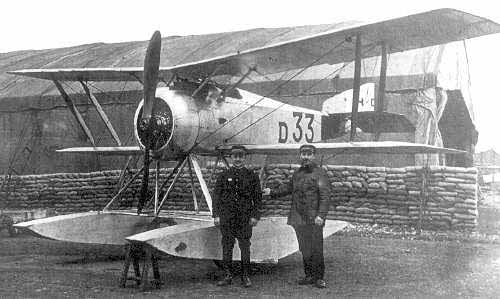
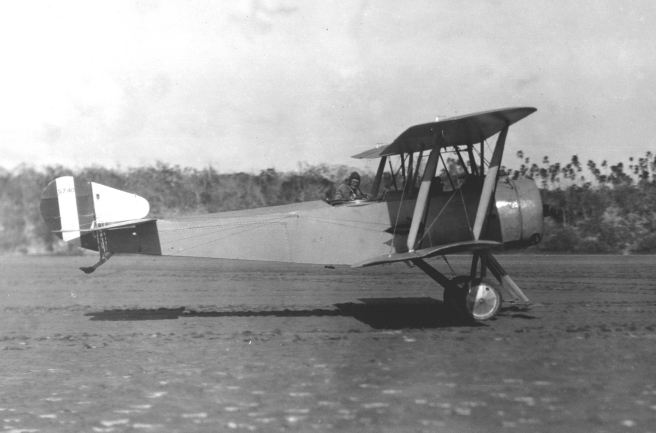
The fly-off platform consisted of 2 parts. The first was a permanent wood planked platform mounted to the top body of the turret where the aircraft was tied down and stored. The platform was also where all maintenance and repairs were conducted. The platform was shaped like a cross with sufficient space to allow aviation personnel to walk completely around the aircraft and conduct any maintenance needed. The arms of the cross (for access around the wings) was situated at the widest part of the turret and extended the full diameter of the barbette. The aircraft was tied down to this platform in a horizontal position with the tailskid elevated on a sawhorse and its control surfaces (ailerons, elevators and rudder) clamped in the neutral position to prevent the slipstream created by the wind and forward movement of the ship from causing the aircraft taking-off on its own. The second part of the platforms was the “runway”, planks bolted to runners that were clamped to each of the turret’s gun barrels. The runway was separate from the first part to allow the guns to elevate albeit only in unison (same elevation). This part of the platform was something of a “Catch 22”. A Captain must decide whether to keep the runway planks in place allowing the aircraft to be launched quickly but risking the possibility that his crew will not have time to clear the planks from the barrels thus limiting the turrets operation in a gun duel; or keep his guns free of the impairment of the runway and risking not being able to launch the aircraft at all. This would result in the aircraft being pitch over the side to eliminate the fire hazard or having the aircraft reduced to toothpicks by the concussive force of the main battery firing. Therefore one of the drills run by the aviation personnel was to practice laying down and taking up the planking of the runway. This situation meant that most battleship captains did not like the fly-off platforms as they interfered with the primary function of the battleship – gunnery. The US Navy encountered these platforms while serving with the British Grand Fleet during World War I and was sufficiently interested to have the Texas (BB-35) equipped with a platform atop both the No. 2 and No. 4 turrets so that the Navy could conduct its own experiments. These experiments were began on 9 March 1919 when Lt. Cmdr. E. O. McDonnell successfully launched a Sopwith Camel from the No. 2 Turret platform of the Texas at Guantanamo Bay, Cuba. The US Navy improved the survivability of the aircraft when making water landings by adding a horizontal vane, called a hydro-vane, attached to the undercarriage at the same level as the axle and extended forward to below the engine. When the undercarriage struck the water this vane would plane across the surface and bear the weight of the engine thus reducing the chance of the aircraft pitching nose down. In addition the US Navy added 2 inflatable floats to the underside of the lower wing and extending forward about as far as the hydro-vane. These improved the safety of water landings and at the very least kept the aircraft afloat until it could be recovered. Damage to the lower wings and undercarriage were still common and the engine would always have to be completely over hauled (cold saltwater baths for hot engines are never a good mix) after any water landing. Usually these experiments involve the launched aircraft flying to a field and landing on shore. The plane would then be hauled down to the beach and loaded aboard a barge or launch and floated back to the parent ship. The US Navy used 4 different aircraft aboard ships equipped with fly-off platforms: the Sopwith Camel, the Hanriot HD-2, the Nieuport 28 and the Sopwith 1-1/2 Strutter. Three of these aircraft are fighters, which was the original purpose foe adding these aircraft aboard the battleships. The platforms were first mounted the spring and summer of 1919 on all of the US Navy’s 14” gunned battleships. In 1919 this was limited to the six WW I veterans, New York (BB-34), Texas, Nevada (BB-36), Oklahoma (BB-37), Pennsylvania (BB-38) and Arizona (BB-39) plus the 3 newly commissioned battleships New Mexico (BB-40), Mississippi (BB-41) and Idaho (BB-42). The fly-off platforms were mounted on the “super firing turrets”, turrets Nos. 2 and 3 for 4 turreted ships. Because of their 5-turret arrangement, the New York and Texas had the after platform atop the No. 4 turret. Initially a single HD-2 was assigned to each ship (the Sopwith Camel does not seem to have been used beyond testing and training). By 1920 wear and tear on the aircraft and the commissioning of additional battleships required replacement of the HD-2’s. To meet the need the Navy obtained Nieuport 28’s and Sopwith 1-1/2 Strutters from the Army to replace the Hanriot’s. One Nieuport and one Sopwith were to be assigned to each battleship. The commissioning of the Langley (CV-1) in 1922, allowed for the recovery of land based aircraft (such as those used on the fly-off platform) back aboard a ship at sea, which made fly-off platform operation obsolete. However, experiments in 1921 with radio equipped 1-1/2 Strutters showed the advantages of aerial spotting and scouting. All that was need was a means of launching and recovering such an observation airplane from battleships and cruisers. By the spring of 1921, a compressed air powered catapult (Type A) had been developed and were being mounted on turntables situated the fantail of all 4 turreted battleships allowing them to launch floatplanes. The 5 turret main batteries of the Texas and New York as well an those 12” gunned battleships still retained under the provisions of the Washington Naval Treaty did not have enough deck space to mount the catapult and had to settle for simple carrying a float plane one the deck and launching it by lowering over the side for a water take-off. By the end of 1922, fly-off platforms had been removed from all battleships. In 1925 the introduction of the Type P catapult (powered by a gun powder charge) allowed the catapult to be mounted atop the turret of the battle ships those ships not previously equipped to have spotter aircraft. USN photo submitted by Pieter Bakels. Text & photos courtesy of Chris Hoehn. | 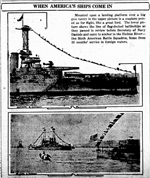 2.36k | WHEN AMERICA'S SHIPS COME IN | Mounted upon a landing platform over a big gun turret in the upper picture is a seaplane poised as for flight, like a great bird. The lower picture shows the line of flag-decked battleships as they passed in review before Secretary of Navy Daniels and came to anchor in the Hudson River—the Sixth American Battle Squadron, home from 18 months' service in foreign waters. Image and text provided by State Historical Society of North Dakota. |
Photo by Bismarck Daily Tribune. (Bismarck, Dakota [N.D.]) 1881-1916, 04 January 1919, Image 1, courtesy of chroniclingamerica.loc.gov. | |||||||||||||||||||||||
| Back To US Battleship Construction Index | Back To The Main Photo Index | Back To The Battleship Photo Index Page |
This page is created by Pieter Bakels and Michael Mohl & maintained by Michael Mohl
All Pages © 1996 - 2025, by Paul R. Yarnall NavSource Naval History. All Rights Reserved.